Overview of the Urinary System and Practical Review Announcement
320 likes | 430 Vues
This announcement provides essential details about the urinary system, including its major functions such as filtering waste, regulating blood composition, and producing hormones like renin and erythropoietin. It highlights the anatomy of the kidneys, ureters, bladder, and urethra, along with information about nephron function and urine formation. Additionally, a practical review session is scheduled for this Sunday from 3-5 PM, following Spring Break, to prepare for the upcoming practical lab on the urinary system.


Overview of the Urinary System and Practical Review Announcement
E N D
Presentation Transcript
Urinary system Lab 7
Announcements • Urinary system • Lab Practical Week after Spring Break • Practical Review this Sunday 23rd at 3-5 pm
Functions of Urinary System • Kidneys carry out four functions • Filter nitrogenous wastes, toxins, ions, etc. from blood to be excreted as urine. • Regulate volume and chemical composition of blood (water, salts, acids, bases). • Produce regulatory enzymes. • Renin – regulates BP/ kidney function • Erthropoeitin – stimulates RBC production from marrow. • Metabolism of Vitamin D to active form.
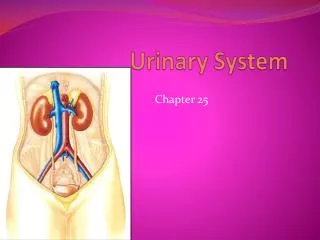
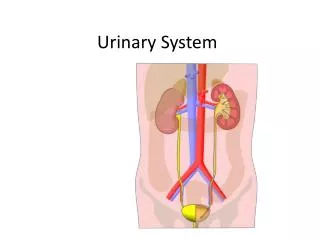
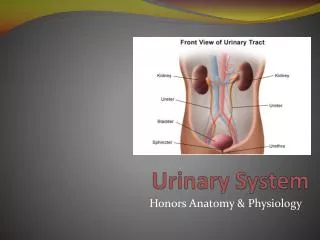
Urinary System • Two Kidneys • Perform all functions except actual excretion. • Two Ureters • Convey urine from Kidneys to Urinary Bladder • Urinary Bladder • Holds Urine until excretion • Urethra • Conveys urine from bladder to outside of body
Kidney general info • Lie against posterior abdominal wall at level of T12-L3. • Right kidney is lower than left kidney due to the shape of the liver. • Lateral surface of kidney is convex while medial is concave. • Concave side has a cleft – Renal Hilus • Inside hilus is Renal sinus • Where kidneys receive renal vessels and nerves.
Kidney External Anatomy • Average size – 12cm x 6cm x 3 cm • Weights 150 grams or 5 oz • Surrounded by three membranes (deep to superficial) • Renal capsule – fibrous barrier for kidneys. • Adipose capsule – fatty tissue designed for protection / stability. • Renal fascia – dense fibrous CTP anchors kidneys/ adrenals/ membrane 1 and 2 to surroundings.
Kidney Anatomy • Renal arteries and veins • Renal cortex • Renal medulla • Nephron • Renal pyramids (6-10) • Renal papilla • Calyx (ces) • Renal pelvis • Ureter
Kidney- External Anatomy • Lateral surface- convex • Medial is concave- • Renal Hilum • Opening to Kidney • Renal Sinus • Space within hilus • Kidneys receive blood vessels and nerves.
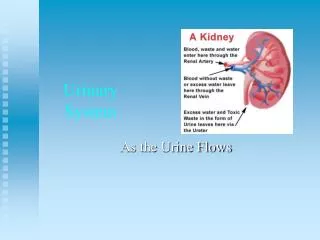
Kidney Internal Anatomy I • Renal arteries and veins • Bring blood in and out of kidney • Renal cortex • Outer layer of Kidney • Renal medulla • Inner layer of Kidney • Nephron
Kidney Internal Anatomy II • Renal Pyramids • Renal Columns • Space between pyramids within the medula • Renal Papilla • Narrow end of pyramid • Calyx (ces) • Collecting tubes • Renal Pelvis • Collecting vessel prior to ureter
Nephron • Blood processing unit which serves to produce urine • 1 million per kidney • Consists of a glomerulus and tubules
Nephron: Vascular System • Afferent arteriole • Glomerulus • Efferent arteriole • Peritubular capillaries • Capillary beds reabsorb in cortex • Vasa recta • Capillary beds reabsorb in medulla
Nephron • Tubular system • Glomerular Capsule • Proximal convoluted tubule • Loop of Henle (nephron loop) • Descending limb • Ascending limb • Distal convoluted tubule • Collecting duct
Dynamic Human Gross Anatomy Urinary system Kidney Nephron
Urine Formation I • Glomerular filtration • Water, ions, amino acids, and glucose get into capsular space from blood • Proteins stay in blood – too big to leave capillaries.
Urine Formation II • Proximal convoluted tubule and Peritubular capillary • Na+ goes down gradient and brings glucose, amino acids, etc. back into blood stream (cotransport). • Reabsorbs about 65% of filtrate.
Descending limb Goes into medulla - increasing salt gradient Water leaves Fluid concentrates Ascending limb Goes up toward cortex - decreasing salt gradient Na+ pumped out Fluid relatively diluted Urine Formation III Countercurrent Multiplication in the Nephron Loop
Urine Formation IV • Collecting duct • Travels down into medulla • Water leaves tubule and enters blood • Urine becomes concentrated and enters renal papilla • ADH controls water channel • ADH – Antidiuretic hormone
Dynamic Human Urine Formation
Micturition • Ureters • 25 cm long • Enters on the floor of bladder • Urinary Bladder • Muscular sac on floor of pelvic cavity • Muscle layer formed by detrusor muscle • Average bladder volume is 500 ml • Max capacity is 700-800 ml
Micturition • Urethra • Conveys urine out of body • Female urethra – 3 - 4 cm • Opens into external urethral oriface • Lies between vaginal oriface and clitoris • Male urethra – 18 cm • 3 regions • Prostatic urethra – 2.5 cm • Membranous urethra – 0.5 cm • Penile urethra – 15 cm
Micturition Reflex Bladder with >= 200 ml of urine Sensory input to parasympathetic system Contraction of detrusor muscle and relaxation of internal urethral sphincter Relaxation of external urethral sphincter
Kidney stones • A hard granule of calcium, phosphate, uric acid and protein. • Form in renal pelvis and get lodged in pelvis or ureter. • Caused by urinary tract infections, dehydration, pH imbalances, or an enlarged prostate gland. • Treated with stone dissolving drugs, surgical removal, or lithotripsy (ultrasonic vibrations)
Dynamic Human Visualizing the Urinary System Intravenous pyelography Ultrasound
Dissection • Be able to identify layers of the kidney on human material • Be able to locate kidneys, ureters, urinary bladder, and urethra on cat.
Next Week – Spring BreakWeek After - Practical II • Material over lymphatic, respiratory, and urinary systems • Review Sunday (end of break) at 3-5pm • Remember – some questions will be based on identifying structures on the cats.