Basic Logarithmic and Exponential Integrals
In this lesson, we review key concepts related to logarithmic and exponential integrals, focusing on the general power formula and its exceptions. We recall that integration is the inverse of differentiation and outline the importance of absolute values when integrating natural logarithms. We delve into practical examples, including integrating exponential functions and understanding areas under curves. Additionally, we explore applications such as drug dosage effects on body temperature, guiding students through indefinite integrals and determining constants of integration.

Basic Logarithmic and Exponential Integrals
E N D
Presentation Transcript
Basic Logarithmic and Exponential Integrals Lesson 9.2
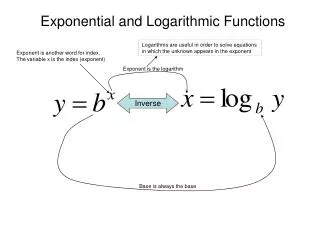
Review • Recall the exception for the general power formula • Recall also from chapter 8 that • We will use this and the fact that the integral is the inverse operation of the derivative
Filling in the Gap • Since then • Note the absolute value requirement since we cannot take ln u for u < 0 • Thus we now have a way to take the integral ofwhen n = -1
Try It Out! • Consider • What is the u? • What is the du? • Rewrite, integrate, un-substitute
Integrating ex • Recall derivative of exponential • Again, use this to determine integral • For bases other than e
Practice • Try this one • What is the u, the du? • Rewrite, integrate, un-substitute
Area under the Curve • What is the area bounded by y = 0, x = 0, y = e –x, and x = 4 ? • What about volume of region rotated about either x-axis or y-axis?
Application • If x mg of a drug is given, the rate of change in a person's temp in °F with respect to dosage is • A dosage of 1 mg raises thetemp 2.4°F. • What is the function that gives total change in body temperature? • We are given T'(x), we seek T(x)
Application • Take the indefinite integral of the T'(x) • Use the fact of the specified dosage and temp change to determine the value of C + C
Assignment • Lesson 9.2 • Page 362 • Exercises 1 – 33 odd