Pythagorean theorem
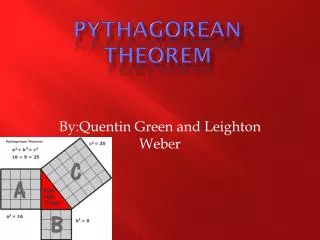
The Pythagorean theorem is a fundamental relation in Euclidean geometry that connects the three sides of a right triangle. Expressed as the equation ( a^2 + b^2 = c^2 ), where ( c ) is the hypotenuse, it illustrates how the lengths of the sides relate to one another. Real-life applications include calculating distances in scenarios like a baseball diamond, determining building heights, and positioning moving truck ramps. Pythagorean triples, such as (3, 4, 5), are sets of three positive integers that satisfy this relation and are widely used in various mathematical contexts.

Pythagorean theorem
E N D
Presentation Transcript
Pythagorean theorem By:Quentin Green and LeightonWeber
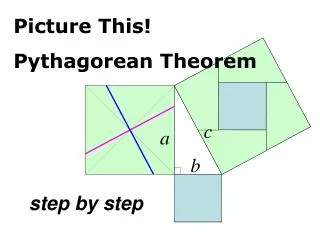
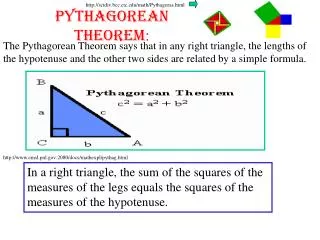
What is the Pythagorean theorem? • a relation in Euclidean geometry among the three sides of a right triangle (right-angled triangle). • theorem can be written as an equation relating the lengths of the sides a, b and c, often called the Pythagorean equation
Real-life examples • Baseball Diamond • Height of a Building • Two friends meeting at a specific destination • Ramp of a moving truck • Measurement of TV
Pythagorean triples • consists of three positive integers a, b, and c, such that a2 + b2 = c2. • such a triple is commonly written (a, b, c), and a well-known example is (3, 4, 5). If (a, b, c) is a Pythagorean triple, then so is (ka, kb, kc) for any positive integer k
Resources • en.wikipedia.org/wiki/Pythagoreantriple • en.wikipedia.org/wiki/Pythagoreantheorem A video http://www.youtube.com/watch?v=CAkMUdeB06o