Download
1 / 13
160 likes | 317 Vues
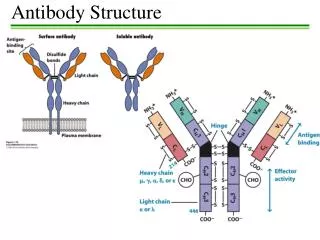
Antibodies, or immunoglobulins, have a distinct 4-chain structure consisting of two identical heavy chains (H) and two identical light chains (L) linked by disulphide bonds. There are five major classes: IgG, IgM, IgA, IgD, and IgE, each serving unique functions in immune response. IgG is the most abundant, providing passive immunity and long-lasting protection, while IgM is the largest and first to appear after immunization. Other classes, like IgA and IgE, play crucial roles in mucosal defense and allergic reactions, respectively. Understanding these mechanisms is vital for the study of immunology.

E N D
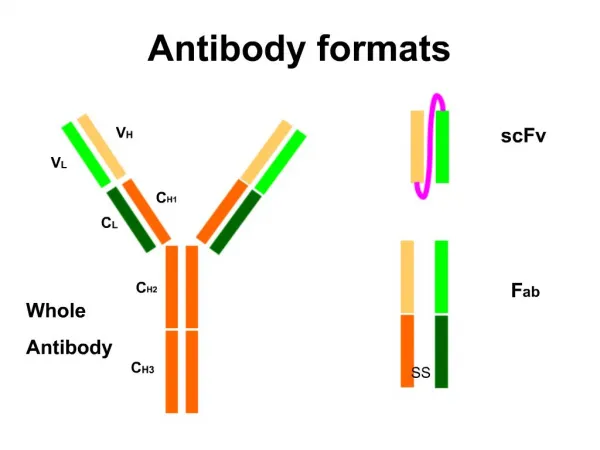
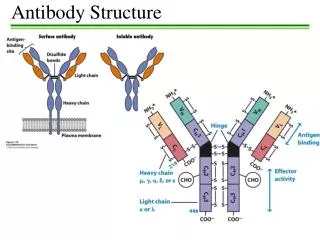
Antibody: The basic structure of antibody molecules, it has a 4 chain structure, 2 identical heavy chain (H) and two identical light chain (L) held together in a loop by disulphide bond . the H and L chains include the antigen binding site and constant region .
Classification of immunoglobulinaccording to the variation in constant heavy chain : • There are 5 major classes of Igs: • 1. IgG (Gamma immunoglobulin) • There are 4 subclasses (IgGl,IgG2,IgG3,IgG4). • It is the only IgG that passes from the mother to the fetus. So produce passive immunization. • It is representing (75-80%) Of Igs in serum
It is not synthesized in fetal life. • It is can activation complement throw classical pathway. • It is long life spin (30-35)days. • Represented secondary immune response, so IgG is the most abundant Ig in serum & also in intracellular fluid. • 2. IgM: • It is th largest one of immunoglobulin, t is pentamer. • It is the first Igs appear after immunization (primary immune response).
Life spin (5-7)days. • It is It is only the Ig that synthesized during fetal life. • It is important in defense against bacteria &viruses. • The main Ig produced early in the primary I.R. because 1gM present on the surface of B cells. • 3. IgA (Alpha Immunoglobulin) • It is a secretary type of immunoglobulin found in different secretion such as saliva, milk, tears & the secretion of the respiratory system, intestinal genital tract.
It is protect mucus membrane from attack by bacteria & virus infection • It is usually found as dimer (2 units) cause neutralizing for virus infection. • 4. IgD: • Acts as Ag receptors when present on the surface of certain B-Lymphocyte. • Found in very small amount in serum.
5. IgE: • It is produced by plasma cell, but taken by specific IgE receptors on mast cell (in tissue) & in basophile in serum. • IgE usually found in small amount in serum body fluid. mainly against parasite infection & causing increase permeability that lead to inducing chemo tactic by degranulation.
Mechanism of immune response: • There are two types of immuneresponse , primary immune response in which characterized by predominant of IGM , low antibody titer with short time and present of lag phase ( lag phase is the period of time that required to sensitized immune response . • While secondary immune response more active with long time and predominant of IGM without lag phase, also characterized by present of memory cells .
Antibody tittered Antibody tittered
Anatomy of immne system • Stem cells of immune system generally originated from tolk sac in first six weeks of gestation , then liver takes this function till 12 months after that bone marrow will take this function at origination and proliferation of stem cells which are renewal cells. • primary lymphoid organ ( central lymphoid tissue ): • the first organ for maturation and proliferation of T-lymphocyte is thymus , while the first organ of maturation and proliferation of B-lymphocyte is still unknown .
seconday organ (peripheral lymphoid tissue ) : • that include lymph nodes, spleen , tonsil , mucosa associated lymphatic tissue (MALT).
Bone marrow generate stem cells erythroid Lymphoid Myeloid lymphocyte mylocytes platelet RBC Large granular Small granular Natural cell Killer cell T-lymphocyte B-lymphocyte basophile eosinophile neutrophile monocyte macrophage