
Human Circulation
E N D
Presentation Transcript
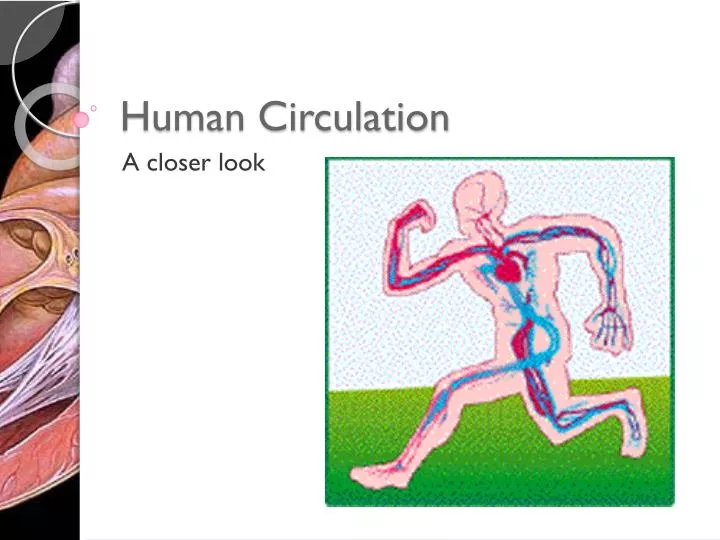
Human Circulation A closer look
Contents • Cardiac cycle • Maintenance of heartbeat • Principles governing blood circulation • Blood composition and function • Cardiovascular disease • Lymphatic system
Electrical activity of the heart 1 - Sinoatrial node (Pacemaker)2 - Atrioventricular node3 - Atrioventricular Bundle (Bundle of His)4 - Left & Right Bundle branches5 - Bundle Branches 6 - Purkinje fibers AV valves SL valves
Pulse • Stretching of arteries as an effect of heartbeat • Pressure waves moving the artery walls when blood moves into aorta • Usually accurate measure of heart rate • Normal resting pulse is 60-100 bpm • Common pulse points 1. Temporal artery 3. Carotid artery 4. Brachial artery 5. Radial artery
Cardiac output • Total volume of blood pumped by the left ventricle per minute • Heart rate (HR) # beats per minute • Stroke volume (SV) mL • Product gives the cardiac output (Q) • Average adult Q = HR x SV = 70 beats/min x 75 mL/beat = 5.25 L/min • Maximum HR = 200-your age • Training heart rate is 75% MHR • e.g. 200-15 = 185 * 0.75 = 139 beats/min • 20 minutes, 3x a week
Physical principles governing blood circulation • Blood flow velocity • Aorta (30 cm/s) • Capillaries (0.026 cm/s) • Law of continuity • Volume of flow per second must be constant through the entire pipe • Total cross-sectional area of the capillaries determines flow rate • Blood flow slows down in capillary beds
Blood pressure • Force exerted by blood on walls of vessels • Pressure decreases from arteries to veins • Determined by cardiac output and peripheral resistance by arterioles • Arterial pressure measured by a sphygmomanometer • Systolic/Diastolic (mmHg) • Factors • Heart rate • Blood volume • Resistance of vessels • Viscosity
Cardiovascular disease • Cardiovascular disease (>50% of all deaths) • Hypercholesterolemia: LDL, HDL • Hypertension: high blood pressure • Atherosclerosis: arterial plaques deposit • Arteriosclerosis: plaque hardening by calcium deposits • Heart attack- death of cardiac tissue due to coronary blockage • Stroke- death of nervous tissue in brain due to arterial blockage
Lymphatic System • Functions • Returns excess body fluid to blood • Transports fats from intestines to blood • Defense • Anatomy • Lymph nodes scattered throughout body (thymus, spleen) • Vessels
Check-up Quiz • What is ventricular systole? • What makes the “lub dub” sound? • Give one difference between an artery, a capillary, and a vein. • Name one factor that can raise blood pressure. • Name one substance that should be present before a blood clot can form.