
Empirical Work
E N D
Presentation Transcript
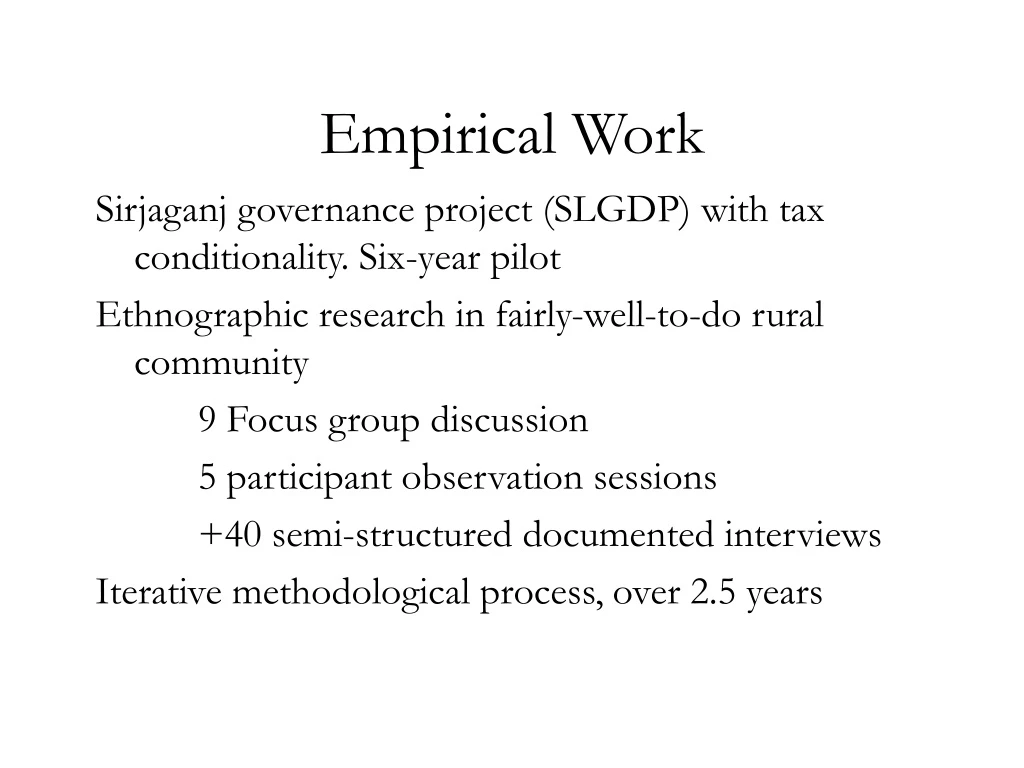
Empirical Work Sirjaganj governance project (SLGDP) with tax conditionality. Six-year pilot Ethnographic research in fairly-well-to-do rural community 9 Focus group discussion 5 participant observation sessions +40 semi-structured documented interviews Iterative methodological process, over 2.5 years
Fund-Matching (taxation) to stimulate citizen driven reform – scope and limits of an emerging donor methodology Two-part paper Fund-matching (taxation) Speech and Voice Jens Stanislawski – Ph.D. candidate, University of Bath (jens.stanislawski@gmail.com)
Part One - fund-matching Why Taxation? Aid as a resource curse (Sobhan 2004 CPD - reduce dependency) Comparative perspective (e.g. USA / Sweden) - obvious governance link Geof Wood’s observation (1994) ‘state without citizens’
Union Example - SLGDP SIRAJGANJ • Exponential Fund-matching (x10) (UNDP/EU) • Range Taka 50-500 / annum - homestead value • Compliance method: Formal rights as precondition: a) pre-consultation b) Open Budget meeting • Compliance still problematic, e.g., by 2006, 90 % compliance in Neogaon Union
Good Gov indications:a) Budget up 300 %b) Public goodsc) Inclusion expandedc) Community policingd) Shalish to Village Courte) Spending + transparency + inclusion = trust over time Contra indications: • Threat of coercion • Problematic representation (‘invitation’) • Tax on property regardless of income
Taxation implies Voice, Speech - in Bangladesh • Causality? Not clear. But, good governance in context of taxation • Heightens relevance of ‘accountablilty’ • Citizenship closer towards contractual paradigm? • Conclusion, Taxation as proxy for wider discussion on ‘justice as fairness’, rights, correlative duties.
Part Two - Speech and Voice Consider hypothetical scenario where state / donors extrapolates SLGDP across a) all unions and, b) central level Good idea? If (and only if) ‘guarantee’ speech / voice Consider new conditionality agreement (switch aid only if fund-matching + speech)
How speech / voice is ‘guaranteed’ elsewhere: • Individual speech in America • Collective voice in Sweden - why? • ‘Conditions’ at ‘formative moment’ of constitutional democracy • Sweden, post industrial, with severe class privilege encoded in law • America, agrarian, ‘class-less’
Divergence of emphasis Two types of citizenship • Liberal (restrict state power), speech, private property • Socialist (expand state power), voice, welfare, common property Each has ‘second avenue’ of representation: • USA - Fair trial = ‘jury of peers’ • Sweden - +80% union density
Interesting Peculiarities • Why does socialist democratic labor party need monarchs? • Why do Americans need all-powerful judiciary with `‘peers’? • Hypo: Last line of defense - tyranny of incumbent!
Conclusion Implications for Bangladesh: • If fund-matching need speech and or voice ‘guaranteed’ - consequences in case of violation! (e.g. fair trial, industrial blockade permit) • Which “second avenue” of representation for agrarian population to national level? • Consider access to fair trial by ‘peers’, basic civil rights as minimum requirements for good governance and citizenship • Finally, ‘peers’ are reason why law is ‘profitable’ in America.