SlideServe
Menu
Préférences
© SlideServe · v2026

The Comprehensive Guide to RAM Manufacturing: From Silicon to Smart Memory

rosina avatar
15 diapositives · 316 Views · Jul 10, 2014

Explore the intricate process of Random Access Memory (RAM) production in this detailed overview by Kyle Hershey and Jason Maldonis. Learn about the different types of RAM, such as dynamic (DRAM) and static (SRAM), and their unique characteristics. Dive into the materials used, including silicon, copper, and polymers, alongside the innovative techniques like UV light etching and electroplating. This guide is perfect for tech enthusiasts and anyone curious about computer memory technology, presenting both the fundamentals and the complexities of RAM fabrication.
The Comprehensive Guide to RAM Manufacturing: From Silicon to Smart Memory - slide 1
01 / 15The Comprehensive Guide to RAM Manufacturing: From Silicon to Smart Memory
1 / 17

Télécharger la présentation

The Comprehensive Guide to RAM Manufacturing: From Silicon to Smart Memory
Une image / un lien ci-dessous est fourni (tel quel) pour télécharger la présentation

Politique de téléchargement : le contenu du site vous est fourni TEL QUEL pour votre information et votre usage personnel ; il ne peut être vendu, concédé sous licence ni partagé sur d’autres sites sans l’accord de son auteur.Le contenu vous est fourni TEL QUEL, pour votre information et votre usage personnel uniquement. Téléchargez la présentation en cliquant sur ce lien. Lors du téléchargement, si vous ne parvenez pas à télécharger une présentation, l’éditeur a peut-être supprimé le fichier de son serveur.Pendant le téléchargement, si vous ne parvenez pas à obtenir une présentation, le fichier a peut-être été supprimé par l’éditeur.

F I N

Plus de contenu associé

Transcription de la présentation
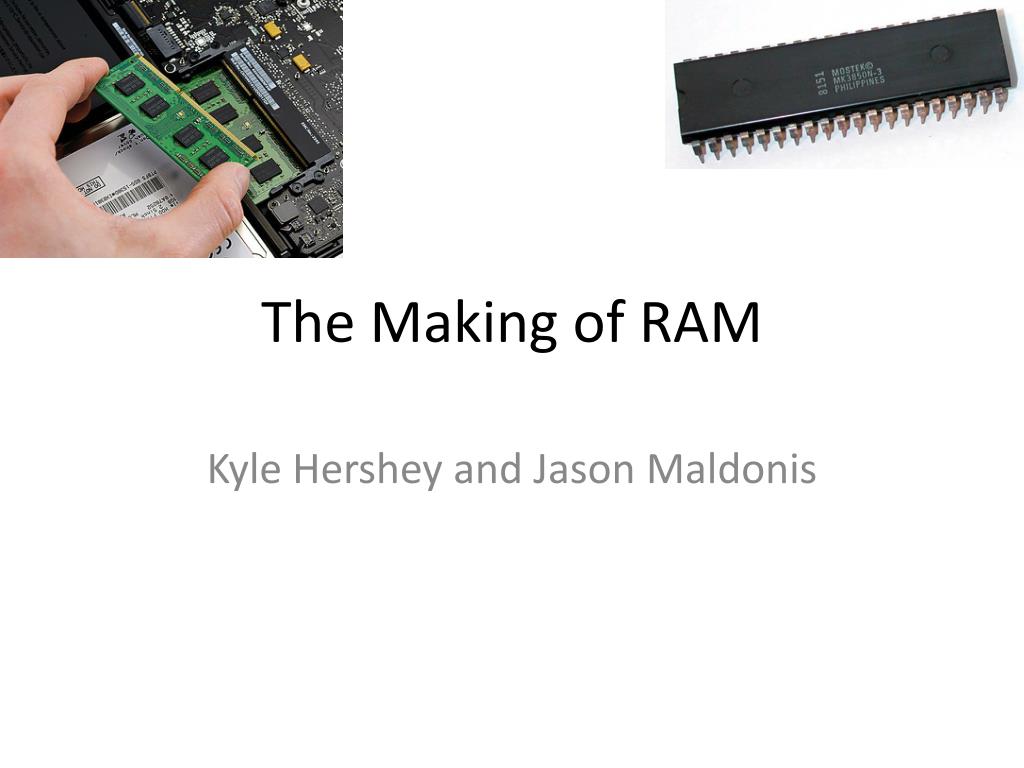
  1. The Making of RAM Kyle Hershey and Jason Maldonis

  2. RAM • Random Access Memory • Used for quick access computer data storage • Handles temporary program data

  3. Types of RAM • dRAM-dynamic random access memory • uses capacitors to store data • Capacitors leak charge, so has to be refreshed • Thus dynamic • sRAM-static random access memory • Uses 4-6 transistors to store data • Doesn’t need refreshing • Most popular modern RAM

  4. Materials • Silicon • Packaging (Various plastics) • Copper conducting layers • Insulating Substrate • Polymers • Polytetraflouroethylene (Teflon) • Cotton, glass, epoxy composites

  5. Making Memory Die • Silicon wafer with array of die

  6. Silicon as a Transistor • Silicon can be used as transistor • Transistor • Switch • Amplifier • Doping of Silicon • Group III – p-type semiconductor • Group V – n-type semiconductor • Used in combination to create transistor in silicon

  7. Making Transistors • Wafer coated in organic material • Desired pattern etched out using UV light • Doping

  8. Making connections: • Wafer coated in organic material • Desired pattern etched out using UV light • Electoplate wafer. Will only fill in where organic material isn’t. Creates the lines. • Repeat 2 and 3 for multiple layers of electronics • Piranha (chemical) removes organic material • H2SO4 and H2O2 • Acid wash to remove copper foil

  9. Photoresist and Base layer Piranha wash UV patterning Acid Wash Electroplating

  10. Making of a Chip http://www.youtube.com/watch?v=Q5paWn7bFg4&feature=related

  11. Packaging • Insulates delicate die • Bond IC to connector • Wirebonding • Flip Chip

  12. Hermetic Seal • Protects connections and IC from corrosion • Seals IC in reduced atmosphere / inert gas • Polymers/ceramics • Usually polymer for RAM

  13. Preparing Substrate • Cut to proper shape • Electrical connections • Patterned using electroplating similar to die.

  14. Attachment • Packages placed by machine. • Flux and solder • Heated to melt solder, flux goes away. • Other components attached

  15. Links for information • http://www.bit-tech.net/hardware/cpus/2010/06/10/how-to-make-a-cpu-from-sand-to-shelf/1 • http://www.madehow.com/Volume-2/Printed-Circuit-Board.html