Download
1 / 1
10 likes | 149 Vues
Medical degrees often lack inter-professional learning, leading to persistent hierarchies in the NHS. The Royal Army Medical Corps (RAMC) offers a unique platform for NHS staff to collaborate during challenging training, fostering cooperation among various healthcare professionals such as physician assistants, physiotherapists, and pharmacists. This experience, including disaster response training and social integration, can reshape attitudes towards teamwork in healthcare. Personal reflections on the impact of the Territorial Army experience highlight the development of a unified healthcare approach, breaking down traditional barriers and enhancing integrated training.

E N D
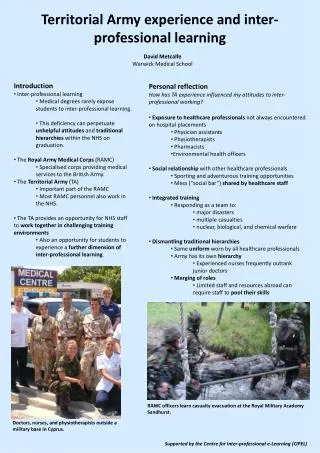
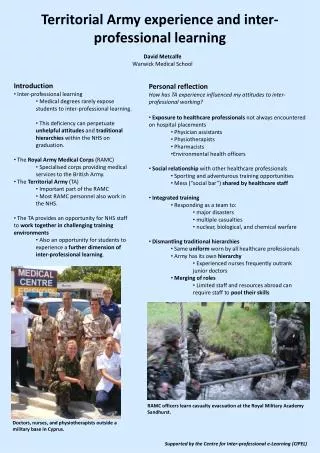
David Metcalfe Warwick Medical School • Introduction • Inter-professional learning • Medical degrees rarely expose students to inter-professional learning. • This deficiency can perpetuate unhelpful attitudes and traditional hierarchies within the NHS on graduation. • The Royal Army Medical Corps (RAMC) • Specialised corps providing medical services to the British Army. • The Territorial Army (TA) • Important part of the RAMC • Most RAMC personnel also work in the NHS. • The TA provides an opportunity for NHS staff to work together inchallenging training environments • Also an opportunity for students to experience a further dimension ofinter-professional learning. • Personal reflection • How has TA experience influenced my attitudes to inter-professional working? • Exposure to healthcare professionals not always encountered on hospital placements • Physician assistants • Physiotherapists • Pharmacists • Environmental health officers • Social relationship with other healthcare professionals • Sporting and adventurous training opportunities • Mess (“social bar”) shared by healthcare staff • Integrated training • Responding as a team to: • major disasters • multiple casualties • nuclear, biological, and chemical warfare • Dismantling traditional hierarchies • Same uniform worn by all healthcare professionals • Army has its own hierarchy • Experienced nurses frequently outrank junior doctors • Merging of roles • Limited staff and resources abroad can require staff to pool their skills Territorial Army experience and inter-professional learning RAMC officers learn casualty evacuation at the Royal Military Academy Sandhurst. Doctors, nurses, and physiotherapists outside a military base in Cyprus. Supported by the Centre for Inter-professional e-Learning (CIPEL)