Fractional Factorial Designs in Wool Fabrics Shrinkage Measurement
90 likes | 266 Vues
Understand how to use fractional factorial designs for effective shrinkage measurement in wool fabrics. Learn about confounding, defining contrasts, generalized interactions, and Aliased Effects in experimental setups.


Fractional Factorial Designs in Wool Fabrics Shrinkage Measurement
E N D
Presentation Transcript
Fractional Factorial Designs 27 – Factorial Design in 8 Experimental Runs to Measure Shrinkage in Wool Fabrics J.M. Cardamone, J. Yao, and A. Nunez (2004). “Controlling Shrinkage in Wool Fabrics: Effective Hydrogen Peroxide Systems,” Textile Research Journal, Vol. 74 pp. 887-898
Fractional Factorial Designs • For large numbers of treatments (k), the total number of runs for a full factorial can get very large (2k) • Many degrees of freedom are spent on high-order interactions (which are often pooled into error with marginal gain in added degrees of freedom) • Fractional factorial designs are helpful when: • High-order interactions are small/ignorable • We wish to “screen” many factors to find a small set of important factors, to be studied more thoroughly later • Resources are limited • Mechanism: Confound full factorial in blocks of “target size”, then run only one block
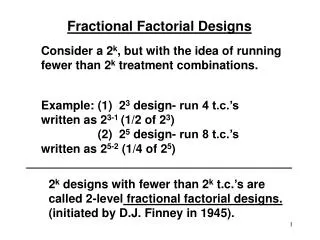
Fractioning the 2k - Factorial • 2k can be run in 2q block of size 2k-q for q=,1…,k-1 • 2k-q factorial is design with k factors in 2k-q runs • 1 Block of a confounded 2k factorial • Principal Block is called the principal fraction, other blocks are called alternate fractions • Procedure: • Augment table of 2-series with column of “+”, labeled “I” • Defining contrasts are effects to be confounded together • Generators are used to create the blocks by +/- structure • Generalized Interactions of Generators also have constant sign in blocks • Defining Relations: I = A, I = -B I = -AB
Example – Wool Shrinkage • 7 Factors 27 = 128 runs in full factorial • A = NaOH in grams/litre (1 , 3) • B = Liquor Dilution Ratio (1:20,1:30) • C = Time in minutes (20 , 40) • D = GA in grams/litre (0 , 1) • E = DD in grams/litre (0 , 3) • F = H2O2 (0 , 20 ml/L) • G = Enzyme in percent (0 , 2) • Response: Y = % Weight Loss • Experiment: Conducted in 2k-q = 8 runs (1/16 fraction) • Need 24-1 Defining Contrasts/Generalized Interactions • 4 Distinct Effects, 6 multiples of pairs, 4 triples, 1 quadruple
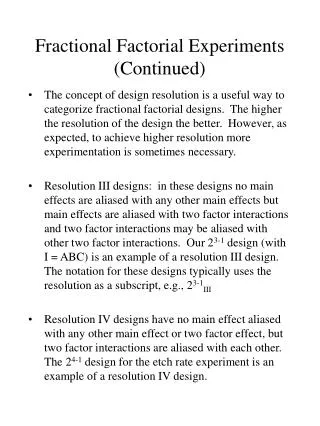
Defining Relations • I = ADEG = BDFG = ACDF = -BCF • Generalized Interactions: • (ADEG)(BDFG)=ABEF,(ADEG)(ACDF)=CEFG,(ADEG)(-BCF)=-ABCDEFG • (BDFG)(ACDF)=ABCG,(BDFG)(-BCF)=-CDG,(ACDF)(-BCF)=-ABD • (ADEG)(BDFG)(ACDF)=BCDE, (ADEG)(BDFG)(-BCF)=-ACE • (ADEG)(ACDF)(-BCF)=-BEG, (BDFG)(ACDF)(-BCF)=-AFG • (ADEG)(BDFG) (ACDF)(-BCF)=-DEF • Goal: Choose block where ADEG,BDFG,ACDF are “even” and BCF is “odd”. All other generalized interactions will follow directly
Aliased Effects and Design • To Obtain Aliased Effects, multiply main effects by Defining Relation to obtain all effects aliased together • For Factor A: • A=DEG=ABDFG=CDF=-ABCF=BEF=ACEFG=-BCDEFG=BCG=-ACDG=-BD=ABCDE=-CE=-ABEG=-FG=-ADEF