Enhanced QCD Background Estimation Using Jet Triggers and mEt Spectrum Fitting Techniques
This analysis presents an update on the inclusive jet trigger conditions for the datasets jet_30, jet_3_mon, jet_50, jet_85, and jet_max. It aims to improve the QCD background estimation through mEt spectrum fitting, employing an alternative fitting method to address fluctuations due to different luminosities. The methodology incorporates normalized functions, Gaussian distributions, and exponential functions for comprehensive modeling. Specific luminosities and expected efficiencies facilitate a comparative assessment, ultimately leading to a more accurate QCD background extrapolation across various energy thresholds.

Enhanced QCD Background Estimation Using Jet Triggers and mEt Spectrum Fitting Techniques
E N D
Presentation Transcript
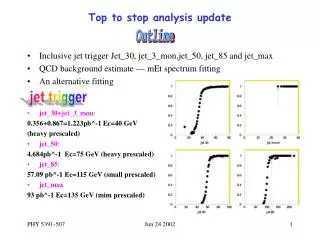
Top to stop analysis update Outline • Inclusive jet trigger Jet_30, jet_3_mon,jet_50, jet_85 and jet_max • QCD background estimate --- mEt spectrum fitting • An alternative fitting • jet_30+jet_3_mon: 0.356+0.867=1.223pb^-1 Ec=40 GeV (heavy prescaled) • jet_50: 4.684pb^-1 Ec=75 GeV (heavy prescaled) • jet_85: 57.09 pb^-1 Ec=115 GeV (small prescaled) • jet_max 93 pb^-1 Ec=135 GeV (mim prescaled) jet trigger Jun 24 2002
QCD estimate: fitting mEt spectrum : Make mEt spectrum at low range and use 3 functions to fitting: normalized function: abexp(-(sqrt(bmEt)-sqrt(bmEtc))/2(1+sqrt(bmEtc) Gaussian: c1exp(-((mEt-c2)^2/2c3) exponential function: exp(c1+mEtc2) Choose the fitting with min chi square as estimated QCD background Because of the bigger difference in luminosity, there are big fluctuations Jun 24 2002
Another fitting procedure • In order remove the fluctuation in QCD, we use an exponential function to fit QCD background at low Et range and extrapolate to high Et range. We use jet_3_mon+jet_30 sample to get QCD at Et>40 GeV because at this range these two triggers are fully efficient. • Or get QCD at high Et range, the low range value is derived from this exponential function. We use jet_85+jet_max sample in order to have good efficieny and good statistics at Et>110 GeV. • Compare luminosities of the two methods, the latter is better. Jun 24 2002