SlideServe
Menu
Préférences
© SlideServe · v2026

Activity 79 Eating for Energy

rylee-mason avatar
11 diapositives · 306 Views · Nov 14, 2014

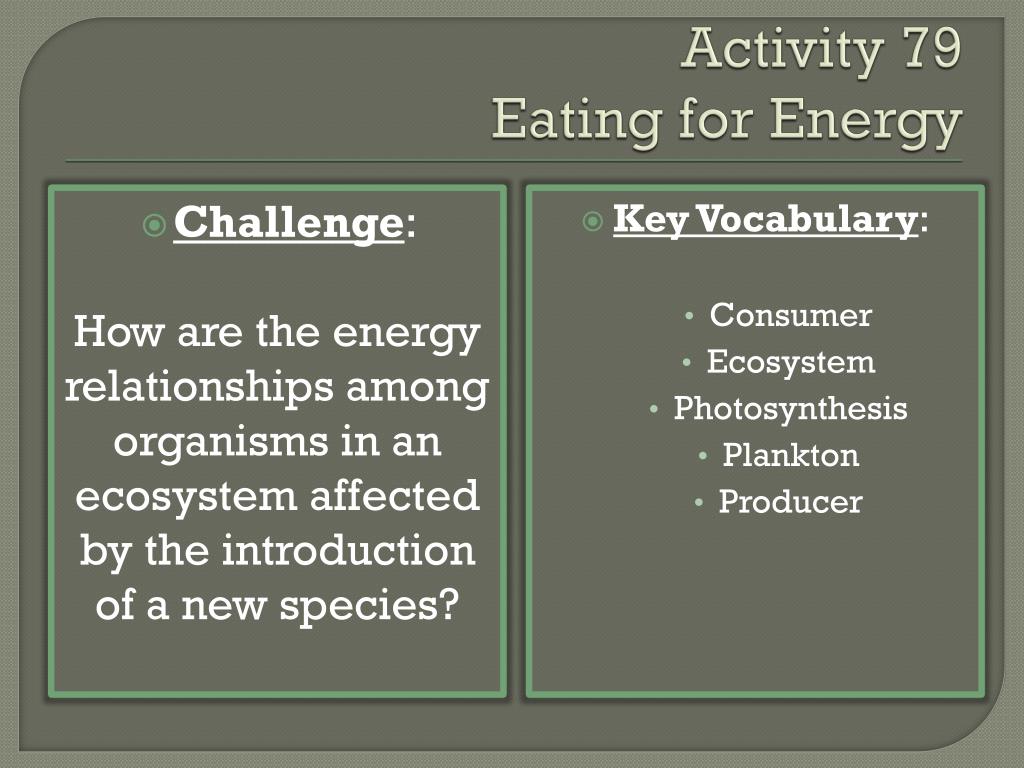
Activity 79 Eating for Energy. Challenge : How are the energy relationships among organisms in an ecosystem affected by the introduction of a new species?. Key Vocabulary : Consumer Ecosystem Photosynthesis Plankton Producer. What foods do humans use as sources of energy?. Humans. Cow.
Activity 79 Eating for Energy - slide 1
01 / 11Activity 79 Eating for Energy
1 / 17

Télécharger la présentation

Activity 79 Eating for Energy
Une image / un lien ci-dessous est fourni (tel quel) pour télécharger la présentation

Politique de téléchargement : le contenu du site vous est fourni TEL QUEL pour votre information et votre usage personnel ; il ne peut être vendu, concédé sous licence ni partagé sur d’autres sites sans l’accord de son auteur.Le contenu vous est fourni TEL QUEL, pour votre information et votre usage personnel uniquement. Téléchargez la présentation en cliquant sur ce lien. Lors du téléchargement, si vous ne parvenez pas à télécharger une présentation, l’éditeur a peut-être supprimé le fichier de son serveur.Pendant le téléchargement, si vous ne parvenez pas à obtenir une présentation, le fichier a peut-être été supprimé par l’éditeur.

F I N

Plus de contenu associé

Transcription de la présentation
  1. Activity 79Eating for Energy • Challenge: How are the energy relationships among organisms in an ecosystem affected by the introduction of a new species? • Key Vocabulary: • Consumer • Ecosystem • Photosynthesis • Plankton • Producer

  2. What foods do humans use as sources of energy? Humans Cow Grass Wheat Consumer: organisms that obtain food by eating other organisms Where does the grass of wheat obtain food?

  3. What makes up an ecosystem? An Ecosystem is a group of living organisms, their habitat, and the non-living things they interact with

  4. Doing the Activity: Attach Student Sheet 79.1 into your notebooks and answer question #1 We will finish #2-3 after we complete the activity.

  5. Stop to Think 1 Brainstorm ways in which zebra mussels might accidentally be spread from one lake to another.

  6. Stop to Think 2 Why are producers such as plants, an essential part of any ecosystem?

  7. Stopping to think 3 • Copy the food web into your notebooks. • Identify each organism as a producer or consumer. • Add humans to this food web. • In the lake food web, humans are consumers. Are humans always consumers? Explain.

  8. Stopping to Think 4 Using the above food web as a guide, create a lake food web that includes zebra mussels. Be sure to show how zebra mussels get their energy AND how other organisms get money from them.

  9. Stopping to Think 5 Look at the zebra mussel map. The lines across the U.S. represent large rivers. Where do you predict zebra mussels will be found in the next 10 years? The next 20 years? The next 50 years? Explain your predictions.

  10. Are producers a necessary part of the Northern pike’s ecosystem?

  11. Analysis Questions 1-3 Answer questions 1-2 in your notebooks. Answer question #3 on the sheet provided.