Advancements in Density Functional Theory for Chemistry and Physics
This document discusses the dual approaches in applying Density Functional Theory (DFT) within the realms of chemistry and physics. It emphasizes the importance of selecting the most accurate functional for specific systems and properties, incorporating additional density-based parameters to fulfill constraints for enhanced accuracy. The work also highlights various studies, including rigorous testing of functionals against experimental results in solid-state physics and quantum chemistry, contributing to the ongoing development of generalized functionals for reliable calculations in diverse scientific applications.

Advancements in Density Functional Theory for Chemistry and Physics
E N D
Presentation Transcript
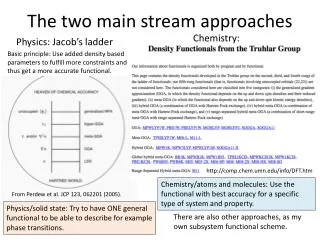
The two main stream approaches Chemistry: Physics: Jacob’s ladder Basic principle: Use added density based parameters to fulfill more constraints and thus get a more accurate functional. http://comp.chem.umn.edu/info/DFT.htm Chemistry/atoms and molecules: Use the functional with best accuracy for a specific type of system and property. From Perdew et al. JCP 123, 062201 (2005). Physics/solid state: Try to have ONE general functional to be able to describe for example phase transitions. There are also other approaches, as my own subsystem functional scheme.
Testing functionals As accuracy improves testing becomes more and more elaborate. P. Haas, F. Tran, P. Blaha: "Calculation of the lattice constant of solids with semilocalfunctionals"; Physical Review B, 79 (2009), 085104. Comparing results for 60 solids with 7 different functionals. In solids testing against carefully extrapolated experimental results John P. Perdew et al: ”Workhorse Semilocal Density Functional for Condensed Matter Physics and Quantum Chemistry"; (revTPSS)Physical Review Letters, 103 (2009), 026403. Testing 6 functionals against lattice constants (21 solids), cohesive energies (15 solids), jellium surface energies (2x4), atomization energies (6 molecules), and enthalpies of formation (223 molecules). For atoms and molecules testing against high level Quantum Chemistry results typically CCSD(T). Yan Zhao and Donald G. Truhlar Design of Density Functionals That Are Broadly Accurate for Thermochemistry, Thermochemical Kinetics, and Nonbonded Interactions J. Phys. Chem. A, 2005, 109 (25), pp 5656–5667 24 different functionals on