Download
1 / 11
110 likes | 224 Vues
Afghanistan, located in Southern Asia, is characterized by arid to semi-arid climates, rugged mountains, and low plains. Covering an area of 652,230 sq.km, it is landlocked and the 41st largest country in the world. The terrain includes its highest point, Noshak at 7,485 meters, and its lowest, Amu Darya at 258 meters. Rich in natural resources like natural gas, coal, and precious stones, Afghanistan also faces environmental challenges, including limited freshwater resources, soil degradation, and air pollution.

E N D
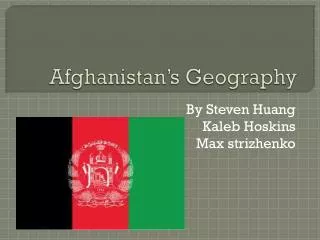
Afghanistan’s Geography By Steven Huang Kaleb Hoskins Max strizhenko
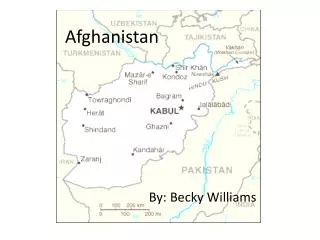
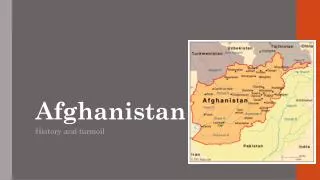
Where It is Located Location: Southern Asia/Middle East Coordinates 33 00 N , 65 00 E
Area Total: 652,230 sq km Land: 652,230 sq km Water: 0 km (landlocked) Country comparison to the World: 41st
Did you know that? Afghanistan is slightly smaller than Texas!
Climate, Terrain, Elevation Climate: Arid to semiarid; cold winters and hot summers. Terrain: mostly rugged mountains, plains in north and southwest Highest Point: Noshak 7,485 meters Lowest Point: Amu Darya 258 meters
Natural Resources Afghanistan has many natural resources such as natural gas, petroleum, coal, copper, chromite, talc, barites, sulfur, lead, zinc, iron ore, salt, precious and semiprecious stones.
Land Use Arable land: 12.13% Permanent crops: 0.21% Other: 87.65% (Recorded in 2005) Irrigated land: 31,990 sq. km (Recorded in 2008)
Water Statistics Total renewable water resources: 65 cu km (1997) Freshwater withdrawal (domestic/industrial/agricultural): Total: 23.26 cu km/yr (2%/0%/98%) Per capita: 779 cu m/yr (Recorded in 2000)
Natural Hazards Damaging earthquakes occur in Hindu Kush mountains, flooding, and droughts!
Enviroment Current Issues: limited natural freshwater resources, inadequate supplies of portable water, soil degradation, overgrazing; deforestation (much of the remaining forests are being cut down for fuel and building materials) desertification, air and water pollution.
Afghanistan's Geography It is obviously drier then most places in the world because of the Middle East.