Understanding Memory Systems: Insights from Neurocognition and Behavioral Evidence
140 likes | 269 Vues
This article explores the distinction between primary and secondary memory systems as posited by William James and supported by neurocognitive evidence. It reviews significant studies, including brain damage cases (e.g., H.M. and K.C.), PET studies, and Tulving’s HERA model, which provides insights on episodic and semantic memory systems. The discussion highlights the limitations of short-term memory (STM) and long-term memory (LTM), detailing empirical studies on memory processes, including serial order effects and the importance of rehearsal. Overall, the article emphasizes the complexity and distinctiveness of memory structures and functions.


Understanding Memory Systems: Insights from Neurocognition and Behavioral Evidence
E N D
Presentation Transcript
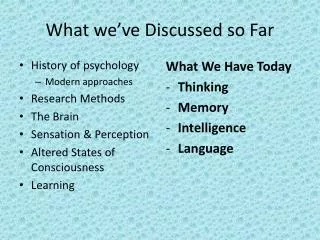
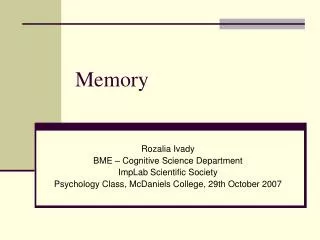
Memory: Brain basis (Neurocognition) Evidence for two memory systems?: See Nee et al (2007) article and pp William James (1900): Made Primary-Secondary memory distinction Evidence for different types of memory: Brain damage studies – H. M & K. C. PET studies: Brain evidence for Tulving’s HERA model (separate Episodic vs. semantic memory systems) Cognitive studies supporting separate memory systems: serial order effects
Nee, et al., STM/LTM article • Damage to Medial Temporal produced LTM deficits while leaving STM in tact. Inferior Temporal = LT visual pattern recognition deficits
STM/LTM distinction: Behavioral evidence – Serial Order Effect
Models of Memory 1:Boxes in Head Model of memory (Attkinson & Shiffrin, 1970’s) • SR – STM – LTM • Each distinguishable based on: • Duration • Representation • Loss • Capacity
Diagram of Three-Stage Memory Model Enhancing Memory
Properties of STM: Early Studies • Waugh/Norman (1965): Early experimental test List of numbers presented 7 9 5 1 2 9 3 8 6 4 3 7 2 (tone) Tone marks repeated number; must recall number coming after repeated number first time (answer: 9) Two variables: rate of presentation: (1/sec; 4/sec Number of intervening items (1-13) If decay then rate should be critical If interference then number of items No effect of rate; significant effect of items.
Memory 2: Structures and Processes STM: Processes – decay or displacement? Waugh & Norman (1965) 3 4 1 9 6 8 2 1 (beep) var: presentation rate (1-4/sec); # of intervening items (1-13). Maintenance of information in STM: necessity of rehearsal – Brown/Peterson Technique Encoding of information in STM: predominance of acoustic codes – Conrad’s confusion matrices Visual codes: Posner Paradigm, mental rotation studies Semantic codes: Wicken’s release from PI studies STM influence by both SR (early) and LTM (late)
Brown/Peterson Technique: Trigram: KNP; 517; backwards by 3 from number for variable amount of time, by 15-18 seconds trigram gone Conrad’s confusion Matrix: Visually presented letters; recall in order; record mistakes; mistakes based on sound or visual image F-P or G-P Posner Paradigm: Letter matching A-a; A-A; visual significantly faster than name until about 1 sec delay. Wickens Release from PI Dogs – distracter-recall; dogs-distracter-recall; dogs-d-r; then switch Sternberg Task Search set (1-6 digits); Comparison number; yes/no part of set? Ex: 6 9 2 5 (9=yes) (7=no) RT’s increase linearly with set size; RT for yes and no equal. Serial/Exhaustive search.
STM Processes (cont.) Retrieval from STM: parallel or serial search; self-terminating or exhaustive? Sternberg paradigm: indicates serial/exhaustive search Baddeley’s Model of Working Memory Central executive Visio-spatial sketchpad Phonological loop Episodic buffer