Discover how the invention of the microscope revolutionized society's perception of disease by enabling the observation of microorganisms and cells. Explore the functions and structures of eukaryotic and prokaryotic cells, the plasma membrane, and organelles.
01 / 78Impact of Microscope on Disease Understanding
1 / 17
Télécharger la présentation
Impact of Microscope on Disease Understanding
Une image / un lien ci-dessous est fourni (tel quel) pour télécharger la présentation
Politique de téléchargement : le contenu du site vous est fourni TEL QUEL pour votre information et votre usage personnel ; il ne peut être vendu, concédé sous licence ni partagé sur d’autres sites sans l’accord de son auteur.Le contenu vous est fourni TEL QUEL, pour votre information et votre usage personnel uniquement.Téléchargez la présentation en cliquant sur ce lien.Lors du téléchargement, si vous ne parvenez pas à télécharger une présentation, l’éditeur a peut-être supprimé le fichier de son serveur.Pendant le téléchargement, si vous ne parvenez pas à obtenir une présentation, le fichier a peut-être été supprimé par l’éditeur.
F I N
Plus de contenu associé
Transcription de la présentation
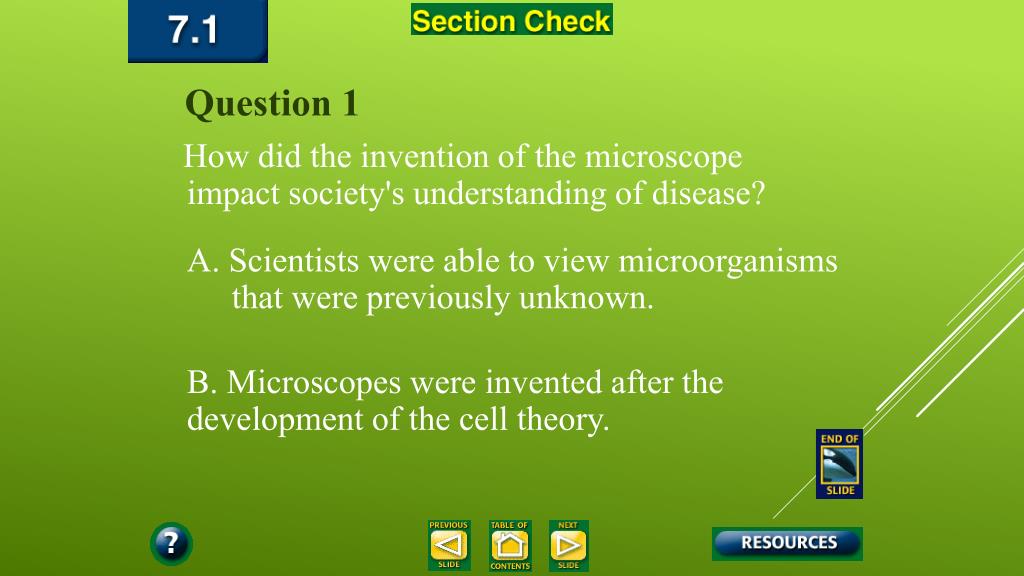
Question 1 How did the invention of the microscope impact society's understanding of disease? A. Scientists were able to view microorganisms that were previously unknown. B. Microscopes were invented after the development of the cell theory. Section 1 Check
Question 1 How did the invention of the microscope impact society's understanding of disease? C. It was once believed that viruses, not bacteria, caused diseases. D. Scientists could view membrane-bound organelles of prokaryotes. Section 1 Check
The answer is A. Before microscopes were invented, people believed that curses and supernatural spirits caused diseases. Microscopes enabled scientists to view cells, which led to the discovery that microorganisms cause some diseases. Section 1 Check
Question 2 Which of the following uses a beam of light and a series of lenses to magnify objects in steps? A. compound light microscope B. scanning electron microscope Section 1 Check C. transmission electron microscope D. simple light microscope
The answer is A. Most microscopes use at least two convex lenses. Compound light microscopes use a light beam and a series of lenses and can magnify objects up to about 1500 times. Electron microscopes use a beam of electrons and can magnify structures up to 500 000 times. Section 1 Check
Question 3 What makes this cell eukaryotic? Nucleus A. Because it has a cell wall. Nucleolus Chromosomes B. Because it contains DNA. Organelles Section 1 Check Plasma membrane
Question 3 What makes this cell eukaryotic? C. Because it has membrane-bound organelles. Nucleus Nucleolus Chromosomes D. Because it does not have DNA. Organelles Section 1 Check Plasma membrane
Question 3 The Answer is C. Eukaryotic cells contain membrane-bound organelles that have specific functions in the cell; prokaryotic cells do not. Nucleus Nucleolus Chromosomes Section 1 Check Organelles Plasma membrane
Question 1 Which of the following best describes the plasma membrane's mechanism in maintaining homeostasis? A. protein synthesis B. selective permeability C. fluid composition Section 2 Check D. structural protein attachment
Question 3 Phospholipid molecule Why is the phosphate group of a phospholipid important to the plasma membrane? Polar head (includes phosphate group) Nonpolar tails (fatty acids) Section 2 Check
When phospholipid molecules form a bilayer, the phosphate groups lie to the outside. Because phosphate groups are polar, they allow the cell membrane to interact with its watery (polar) environments inside and outside the cell. Phospholipid molecule Polar head (includes phosphate group) Nonpolar tails (fatty acids) Section 2 Check
Question 4 Explain why the model of the plasma membrane is called the fluid mosaic model. Section 2 Check
Question 1 What is the primary function of the cell wall? A. act as selectively permeable membrane B. provide support C. control activity of organelles Section 3 Check D. acquire nutrients from environment
Question 3 Which of the following structures is the site of protein synthesis? A. Golgi apparatus B. Ribosome Section 3 Check C. Vacuole D. Lysosome
The answer is B.Ribosomes are the sites where the cell produces proteins according to the directions of DNA. They can be attached to the surface of the endoplasmic reticulum or float freely in the cytoplasm. Section 3 Check
Question 4 What is the advantage of having numerous folds in the ER? A. It enables the ER to lie snugly against the nucleolus. B. It can create more vesicles in a smaller space. Section 3 Check
Question 4 What is the advantage of having numerous folds in the ER? C. It can capture more light energy with more folds. D. A large amount of work can be done in a small space. Section 3 Check
Question 5 What could you predict about a plant cell that contains fewer chloroplasts than other plant cells? A. It contains less chlorophyll. B. It contains a greater number of plastids. C. It will have an increased rate of light energy capture. Section 3 Check D. It will appear darker green in color.
Question 6 A mutation results in the inner membranes of a liver cell's mitochondria being smooth, rather than folded. Which of the following would you expect? A. more efficient storage of cellular energy Section 3 Check B. It can create more vesicles in a smaller space
Question 6 A mutation results in the inner membranes of a liver cell's mitochondria being smooth, rather than folded. Which of the following would you expect? C. decreased energy available to the cell Section 3 Check D. fewer ribosomes available for protein synthesis
Question 1 The diffusion of water across a selectively permeable membrane is called __________. (TX Obj 2; 4B) Water molecule Selectively permeable membrane Sugar molecule Section 1 Check A. active transport B. endocytosis
Question 1 The diffusion of water across a selectively permeable membrane is called __________. (TX Obj 2; 4B) Water molecule Selectively permeable membrane Sugar molecule Section 1 Check C. exocytosis D. osmosis
The answer is D, osmosis. Regulating the water flow through the plasma membrane is an important factor in maintaining homeostasis within the cell. Before osmosis After osmosis Section 1 Check Water molecule Selectively permeable membrane Sugar molecule
Question 2 What is the expected result of having an animal cell in a hypertonic solution? (TX Obj 2; 4B) A. The cell shrivels up. B. The plasma membrane shrinks away from the cell wall. Section 1 Check C. The cell swells up. D. The cell retains its normal shape.
Question 3 A grocer mists the celery display with water to keep it looking fresh. What type of solution is the celery now in? (TX Obj 2; 4B) A. isotonic B. hypotonic C. hypertonic Section 1 Check D. exotonic
Question 4 Transport of materials across the plasma membrane that does not require energy from the cell but does use transport proteins is called __________. (TX Obj 2; 4B) Channel proteins A. osmosis Concentration gradient Section 1 Check Plasma membrane B. simple diffusion
Question 4 Transport of materials across the plasma membrane that does not require energy from the cell but does use transport proteins is called __________. (TX Obj 2; 4B) Channel proteins C. facilitated diffusion Concentration gradient Section 1 Check Plasma membrane D. active transport
Question 1 The stringy structures in the cell nucleus that contain DNA are __________. (TX Obj 2; 4B) A. centromeres B. chromosomes Section 2 Check C. genes D. chlorophylls
Question 2 Look at the diagram and identify the stage of mitosis that is depicted. (TX Obj 2; 4B) Centromere Sister chromatids Section 2 Check A. prophase C. anaphase B. metaphase D. telophase
Question 4 In multicellular organisms, groups of cells that work together to perform a specific function are called __________. (TX Obj 2; 10B) A. organ systems B. organs Section 2 Check C. tissues D. cell cycles
Question 1 Explain cancer in terms of cell growth. (TX Obj 2; 4B, 6C) Answer Cancer is a malignant growth resulting from uncontrolled cell division. The loss of control may be caused by environmental factors or changes in enzyme production that result from defective or changed genetic material. Cancerous cells form masses of tissue called tumors that deprive normal cells of nutrients. Section 3 Check
Question 2 A(n) __________ is a segment of DNA that controls the production of a protein. (TX Obj 2; 4B, 6C) A. gene B. cyclin C. enzyme Section 3 Check D. chromosome
Connexion au compte
Connectez-vous pour publier votre contenu sur SlideServe.