Download
1 / 21
210 likes | 333 Vues
Dive into the mysteries of the Moon, our closest celestial neighbor and a key to understanding Earth's past. This article explores major missions such as Apollo, Luna, and the latest advancements like SMART-1 and Kaguya, focusing on unresolved questions about lunar formation and composition. With over 380kg of samples returned and cutting-edge technology like remote sensing and X-ray spectrometry, we reveal what we still don't know about the Moon and its significance. Join us as we look to the future of lunar exploration with upcoming missions and innovative technologies.

E N D
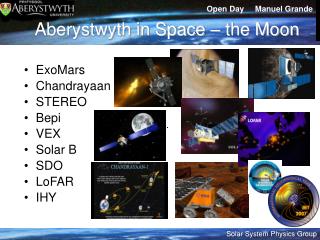
Aberystwyth in Space – the Moon • ExoMars • Chandrayaan • STEREO • Bepi • VEX • Solar B • SDO • LoFAR • IHY
This is a Double Planet. The Moon is the 8th Continent
The Moon • Ancient body • Two major terrains • maria (basalts) • highlands (crust) • Most visited planetary body other than Earth • Window into our past
Apollo and Luna sample returns • 6 Manned Apollo landings • 3 Luna sample returns • Over 380kg rock and soil brought • So you might think we know all about it • WRONG!! • We still don’t know how the Earth moon system formed
+ * + * + * * * Apollo and Luna Landing sites
Unanswered questions about the Moon • How was the Earth Moon system created? • Necessary data for the answer is composition on a global scale (not just from a few landing sites
SMART-1 (ESA) Small Missions in Advanced Research Technology - technology demonstration • Propulsion • Remote sensing: imaging camera IR spectrometer X-ray spectrometer • Radio Science • Telemetry
First time electric propulsion has been used by Europe in space SMART Propulsion
SMART-1 D-CIXS D-CIXS incorporated Two New Technologies • Swept Charge Device (SCD) Detectors • Advanced Microstructure Collimator This Enabled it to provide: • High Throughput X-ray Spectrometer • Compact, light design • Near room temperature operation
D-CIXS X-ray Spectrometer on SMART-1 1 The Sun shines on the Moon (in X rays) 2 The Moon fluoresces 3 Each X-ray energy indicates unambiguously the abundance of a particular element in the surface 4 D-Cixs used two new technologies to detect these X-rays 5 So we can measure what the Moon is made of Sun Shines in X-rays
Detailed task of fitting Lunar composition to the data. This is close to the Apollo 12 landing site
The Future –Kaguya • Japanese KAGUYA was succesfully injected into lunar orbit on Sep. 29 2007 • We are (only) guest investigators on the X-ray instrument • Best ever pictures of the Moon
Mapping the Moon (Google Moon) • Current best contour map of the far side of the Moon • Huge positional errors, as big as 10-20 km • SMART-1 nearly impacted in the wrong place because of this • Tony Cook at Aber, who is one of the world’s experts, pointed this out! • Japanese Selene is a desperately needed mission for accurately mapping the Moon, especially landing sites mission
Lunar Base South Pole
UWA Planetary Analogue Terrain Laboratory “Mars Yard” EU facility ½ scale (ExoMars Phase A) 18 × DoF chassis
UWA Planetary Analogue Terrain Laboratory (PAT Lab.) - 2 Part of PAT Lab. with DLR Mars soil simulant-D UWA PanCam (can be mounted on chassis) UWA 3 DoF ARM and DLR • Mole (can be • mounted • on chassis) Small selection of instruments and science target rocks Link with PAFS-NET
A robot telescope on the Moon Our robot telescope is available for teaching and is also practicing for the Moon! And we provide Seagullcam!
C1XS – Aberystwyth Returns to the Moon! • C1XS in Bangalore after preliminary integration • XSM delivered • Awaiting final integration and launch (19 Sept)