Managing Relative Humidity in Greenhouses: Essential Strategies for Optimal Growth
This guide explores the dynamics of relative humidity (RH) in greenhouses, emphasizing its critical role in plant health. It details the seasonal variations of RH, highlighting high conditions during April-May and August-September, and low conditions from October to March. Strategies for managing humidity levels include ventilation, temperature control, and evaporative cooling techniques. Understanding the balance of transpiration rates, leaf temperature, and disease potential is key to preventing stress and optimizing CO2 uptake. Effective humidity management fosters a healthy growing environment.

Managing Relative Humidity in Greenhouses: Essential Strategies for Optimal Growth
E N D
Presentation Transcript
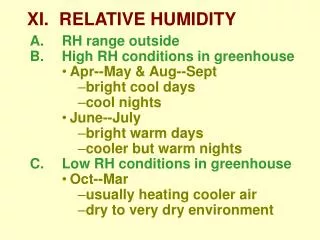
XI. RELATIVE HUMIDITY A. RH range outside B. High RH conditions in greenhouse • Apr--May & Aug--Sept • bright cool days • cool nights • June--July • bright warm days • cooler but warm nights C. Low RH conditions in greenhouse • Oct--Mar • usually heating cooler air • dry to very dry environment
Psychrometric Chart 95% 75% 46%
% Relative humidity Or vapor pressure deficit Water vapor Transpiration rate In g H2O/g leaf C. Object of control • High humidity • Lower transpiration • leaf temp increases • Disease potential greater • Low humidity • Greater transpiration • water stress possible • Stomata close • CO2 uptake less • Death Relative Humidity 0% 100% Vapor Pressure Deficit
Object: • High enough not to cause stress or limit metabolism • 60% • Low enough to prevent disease • less than 85%
Reducing humidity • Ventilation
Reducing humidity • Circulation
Reducing humidity • Increase temperature • Ventilate and heat • Turn off pump to cooling system
E. Increasing RH • Shade roof • Evaporative cooling • Lower temperatures • Spray walks and foliage during day • Continue mist into night
F. Special problems 1. wilting after dark weather • Rapid loss of water from tender foliage • Roots cannot supply enough water 2. edema - oedema • Cells expand; cell wall cracks • Warm soil; High humidity • Cause • rapid uptake of water - low transpiration
Guttation • Small drops of sap on edge of leaf • Water evaporates • High concentration of salts • Cause • high R.H. • rapid water uptake; slow transpiration