Methods for Preparing Salts through Titration and Precipitation
This guide outlines procedures for preparing salts using titration and precipitation methods in a laboratory setting. For titration, an acid is added to an alkali until neutralization, measured by an indicator. The volume of acid used is recorded, and a subsequent reaction creates a dry salt. In precipitation, two soluble salt solutions are combined to form an insoluble salt precipitate, which is filtered, washed, and dried. Specific salts like potassium chloride and copper nitrate are discussed, alongside potential balanced chemical equations.

Methods for Preparing Salts through Titration and Precipitation
E N D
Presentation Transcript
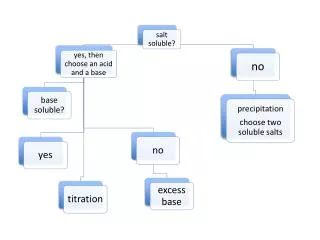
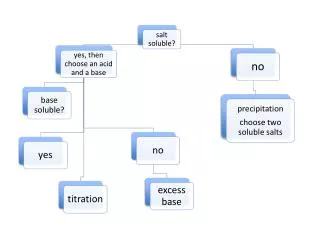
titration • add acid via burette to alkali`+ indicator until neutral (or until temperature stops rising) • measure volume of acid added; throw away • solution as it contains the indicator; • add same volume of acid to same amount of • alkali without indicator • obtain dry salt from solution (see later slide) titration animation
excess base • warm acid • add excess base to acid until no more dissolves (warm acid if necessary) • filter off excess base • obtain salt from (see next slide) excess base animation
obtaining dry salt from solution • Concentrate solution until it becomes saturated which is done by driving off most of the water by heating it. Solution is saturated when crystals form on a glass rod dipped in the solution. • Stop heating and allow solution to cool and salt crystals to form. • Filter the crystals to remove water • Wash crystals with a little water • Dry crystals with filter paper or place on warm gauze.
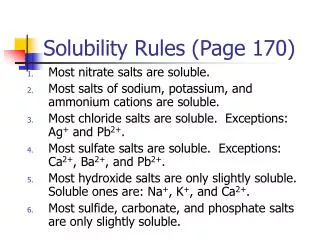
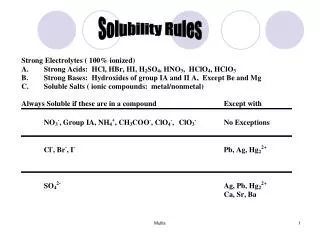
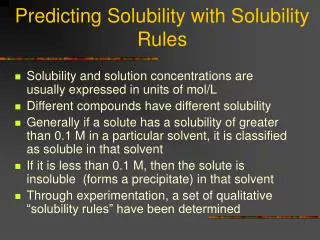
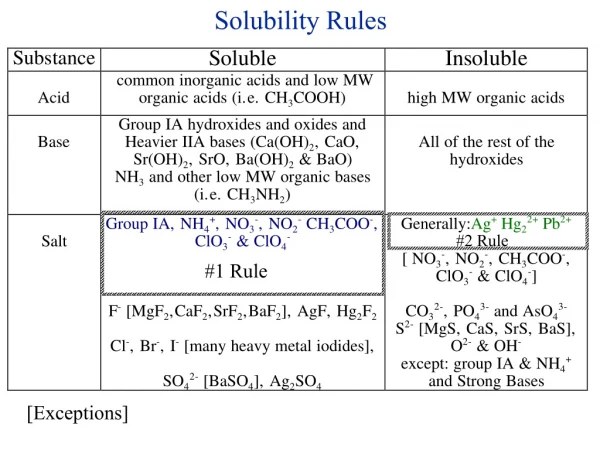
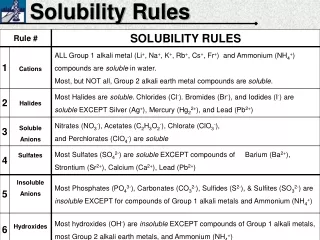
precipitation • make 2 solutions each one containing 1 ion of the salt to be made (use soluble salts!!!) • add the two solutions • filter off the precipitatewhich is the insoluble salt • wash the residue in the filter paper with distilled water • dry with other filter paper or place on warm gauze
precipitation salts experiment Name the precipitates and write word and balanced equations
exercise • For each of the salts below: • Decide on the method you will use • Select appropriate reagents • Salts: • potassium chloride • copper nitrate • lead sulphate • magnesium chloride • ammonium nitrate • calcium sulphate