Understanding Air Masses: Characteristics and Classifications
170 likes | 273 Vues
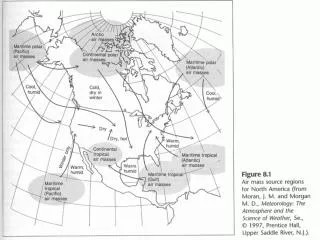
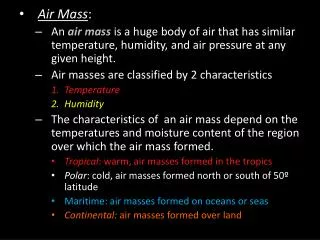
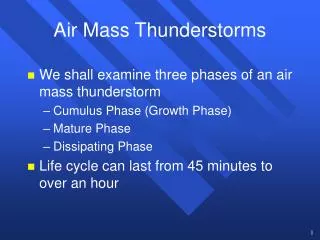
Air masses are categorized based on their temperature and origin. The classifications include "c" for Continental, "m" for Maritime, "A" for Arctic, "P" for Polar, "T" for Tropical. Different combinations of these terms, like cT or mP, describe specific air mass characteristics. For instance, cT represents a Continental Tropical air mass, which is typically hot and dry. Understanding these classifications helps in weather prediction and the study of climatic patterns. Explore key phenomena influenced by air masses, such as Lake Effect Snow and Dust Devils.


Understanding Air Masses: Characteristics and Classifications
E N D
Presentation Transcript
Remember this… Air takes on the characteristics of the earth surface it is above.
What does “c” stand for? A. Crazy daisy • Coastal • Continental • Cool
What does “m” stand for? • Macadamia • Moon Pie • Mocha Latte Grande Luche Nort • Maritime
What does “A” stand for? • Artic • Alapalooza • Africa • A is for apple
What does “P” stand for? • Pre-nuptual • Polar • Pressure • Plop
What does “T” stand for? • Tressle • Trash talk • Tricky troll • Tropical
This air mass would be called? A. cT mT mP cA cP
This air mass would be called? A. cT mT mP cA cP
This air mass would be called? A. cT mT mP cA cP
This air mass would be called? A. cT mT mP cA cP
This air mass would be called? A. cT mT mP cA cP
This air mass would be called? A. cT mT mP cA cP
Air in cT would be… • Cool and humid • Cool and Dry • Dry and Hot • Hot and humid
Air in mT would be… • Cool and humid • Cool and Dry • Dry and Hot • Hot and humid
The rest of today… • Finish the front of your worksheet on the 3 Cell Model. • Take notes on Ch. 7 and 8: specifically • Lake Effect Snow (8) • Siberian Express (8) • Dust Devils (7) • Santa Ana Winds (7) • Country Breeze (7)