Understanding Angles: Notation, Definitions, and Measurements
This comprehensive guide covers the fundamentals of angle measurement, including notations, definitions, and types of angles such as coterminal, right, complementary, and supplementary angles. Learn how to find the measurements in both degrees and radians, including conversions and the significance of the initial and terminal sides. Explore practice problems to reinforce your understanding and ensure you're proficient in identifying and calculating various types of angles. Ideal for students and anyone interested in mastering trigonometry basics.

Understanding Angles: Notation, Definitions, and Measurements
E N D
Presentation Transcript
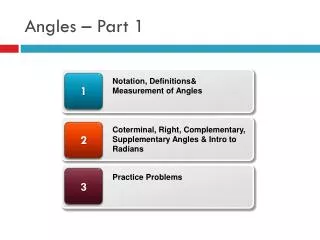
Angles – Part 1 1 Notation, Definitions& Measurement of Angles 2 Coterminal, Right, Complementary, Supplementary Angles & Intro to Radians 3 Practice Problems
Notation • Variables for angles • Frequently Greek letters • a (alpha) • b (beta) • g (gamma) • Q (theta)
Definitions • Initial side • Point of origin for measuring a given angle • Typically 0˚ (360˚) • Terminal Side • Ending point for measuring a given angle • Can be any size
Measurement • Clockwise (CW) • Negative Angle • Counter-Clockwise (CCW) • Positive Angle
Measurement (Cont.) • Degrees • May be in decimal form (72.64˚) • May be in Degrees/Minutes/Seconds (25˚ 43’ 37”) • Minutes ( ’ ) • 60’ = 1˚ • Seconds ( ” ) • 60” = 1’ • 90˚ = 89˚ 59’ 60” www.themegallery.com
Measurement (Cont.) • Radians • Similar to degrees • Always measured in terms of pi (π) • 360˚/0˚ = 2π • 90˚ = π/2 • 180˚ = π • 270˚ = 3π/2
Coterminal Angles • Have the same initial and terminal sides
Finding Coterminal Angles • Add multiples of 360˚ • Subtract Multiples of 360˚ Example: Find 4 coterminal angles of 60˚ 60˚ + 360˚ = 420˚ 60˚ + 720˚ = 780˚ 60˚ – 360˚ = -300˚ 60˚ – 720˚ = -660˚ Answer: 420˚, 780˚, -300˚, -660˚
Defining Angles • Right Angles measure 90˚
Finding Complimentary Angles • For degrees: • = 90˚ - Q or • = 89˚ 59’ 60” – Q Example: Find the angle complementary to 73.26˚
Finding Complementary Angles Example 2: Find the angle that is complementary to 25˚ 43’ 37”.
Finding Complementary Angles • For Radians • = π/2 – Q Example: Find the complementary angle of π/4 radians.
Finding Supplementary Angles • For degrees • = 180˚ - Q • For radians • = π - Q
Practice Problems • Page 409 Problems 1-8