Long-term PM2.5 Benefits from Tier 2 Vehicle Standards: Projections for a Cleaner Future
10 likes | 121 Vues
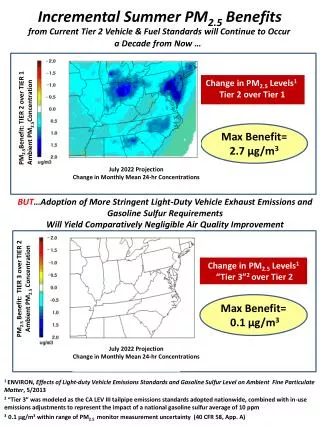
This study projects that the transition from Tier 1 to Tier 2 vehicle standards will result in significant reductions in ambient PM2.5 levels, with a maximum benefit of 2.7 µg/m³ observed by July 2022. However, the adoption of stricter Tier 3 standards promises only a marginal additional benefit of 0.1 µg/m³. While the Tier 2 standards will continue to provide important air quality improvements over the next decade, the incremental benefits of Tier 3 regulations on fine particulate matter are comparatively negligible, indicating the need for further advancements in emission reductions.


Long-term PM2.5 Benefits from Tier 2 Vehicle Standards: Projections for a Cleaner Future
E N D
Presentation Transcript
Incremental Summer PM2.5 Benefits from Current Tier 2 Vehicle & Fuel Standards will Continue to Occur a Decade from Now … PM2.5Benefit: TIER 2 over TIER 1 Ambient PM2.5Concentration Change in PM2.5 Levels1 Tier 2 over Tier 1 Max Benefit= 2.7 µg/m3 July 2022 Projection Change in Monthly Mean 24-hr Concentrations BUT…Adoption of More Stringent Light-Duty Vehicle Exhaust Emissions and Gasoline Sulfur Requirements Will Yield Comparatively Negligible Air Quality Improvement PM2.5 Benefit: TIER 3 over TIER 2 Ambient PM2.5 Concentration Change in PM2.5 Levels1 “Tier 3”2 over Tier 2 Max Benefit= 0.1 µg/m3 July 2022 Projection Change in Monthly Mean 24-hr Concentrations 1 ENVIRON, Effects of Light-duty Vehicle Emissions Standards and Gasoline Sulfur Level on Ambient Fine Particulate Matter, 5/2013 2 “Tier 3” was modeled as the CA LEV III tailpipe emissions standards adopted nationwide, combined with in-use emissions adjustments to represent the impact of a national gasoline sulfur average of 10 ppm 3 0.1 g/m3 within range of PM2.5 monitor measurement uncertainty (40 CFR 58, App. A)