Evaluation and Diagnosis of Psoriasis: Key Indices and Their Impact on Quality of Life
This overview focuses on established methods for diagnosing psoriasis, emphasizing the Psoriasis Area Severity Index (PASI) and Dermatology Life Quality Index (DLQI). The PASI is crucial for assessing skin severity, while the DLQI evaluates the impact of psoriasis on patients' lives, identifying small and significant effects based on score ranges. The document also references the criteria for Psoriatic Arthritis response, detailing measurements like the ACR criteria. Understanding these indices can help improve patient care and quality of life assessments.

Evaluation and Diagnosis of Psoriasis: Key Indices and Their Impact on Quality of Life
E N D
Presentation Transcript
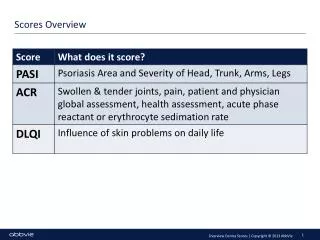
Psoriasis Diagnosis:Psoriasis Area and Severity Index (PASI) Fredriksson T. Pettersson U. Dermatologica. 1978;157(4):238-44. *BSA = Body Surface Area
Psoriasis Arthritis: ACR 20/50/70 Response - Criteria ≥20/50/70 % reduction swollen joints and ≥ 20/50/70 % reduction tender joints and ≥20/50/70% improvement in 3 of the following 5 criteria - Pain (VAS Patient) - Patient global assessment of disease activity (VAS) - Physician global assessment of disease activity (VAS) - Patient‘s assessment of physical function (HAQ) - ESR or CRP Felson D.T. et al. Arthritis and Rheum. 1995
Psoriasis Diagnosis:Dermatology Life Quality Index (DLQI) Score DLQI ≤5: Small effect on patient’s life DLQI >10: Very large effect on patient’s life Scores lie in the range 0–30, lower scores show a better HRQoL. Hongbo Y, et al. J Invest Dermatol 2005;125(4):659–64;
The DLQI Questionnaire “The aim of this questionnaire is to evaluate the influence that your skin problem has had on your life OVER THE PAST 7 DAYS. Please tick one box per question.” Finlay A.Y. et al. Clin Exp Dermatol. 1994; May;19(3):210-6.