Analyzing Angular Acceleration in Beams and Hanging Masses with Pulleys
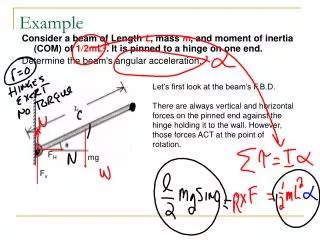
This guide explores the principles of angular acceleration in a beam pinned at one end and the dynamics of a hanging mass wrapped around a massive pulley. The beam, with length L, mass m, and moment of inertia, experiences forces due to its weight and hinge constraints. Likewise, the hanging mass, influenced by gravity and the mass of the pulley, allow us to apply free body diagrams (F.B.D.s) to calculate acceleration. By understanding these mechanics, one can determine the key parameters governing the motion in these systems.

Analyzing Angular Acceleration in Beams and Hanging Masses with Pulleys
E N D
Presentation Transcript
Example Consider a beam of Length L, mass m, and moment of inertia (COM) of 1/2mL2. It is pinned to a hinge on one end. Determine the beam's angular acceleration. Let’s first look at the beam’s F.B.D. There are always vertical and horizontal forces on the pinned end against the hinge holding it to the wall. However, those forces ACT at the point of rotation. FH mg Fv
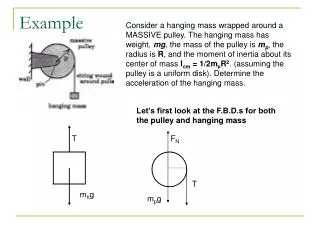
Example Consider a hanging mass wrapped around a MASSIVE pulley. The hanging mass has weight, mg, the mass of the pulley is mp, the radius is R, and the moment of inertia about its center of mass Icm = 1/2mpR2. (assuming the pulley is a uniform disk). Determine the acceleration of the hanging mass. Let’s first look at the F.B.D.s for both the pulley and hanging mass
Example Consider a hanging mass wrapped around a MASSIVE pulley. The hanging mass has weight, mg, the mass of the pulley is mp, the radius is R, and the moment of inertia about its center of mass Icm = 1/2mpR2. (assuming the pulley is a uniform disk). Determine the acceleration of the hanging mass. Let’s first look at the F.B.D.s for both the pulley and hanging mass T FN T mhg mpg
Example cont’ T FN a mhg T mpg