
SlideServe
Menu
Préférences
© SlideServe · v2026

Understanding Bird Migration: Navigation and Behavior Patterns

selia avatar
27 diapositives · 422 Views · Jul 22, 2014

Bird migration represents a unique natural phenomenon intricately connecting continents. This study explores the essential factors guiding migratory patterns, including ultimate triggers like weather and food availability, and proximate factors such as photoperiod and hypothalamic responses. We delve into concepts like "Zugunruhe," the migratory restlessness observed in some species, and the learning aspect of migration routes in social birds. The influence of light and hormones on breeding and migration timing is reviewed, providing insights into the complex annual cycles of these remarkable avian travelers.
Understanding Bird Migration: Navigation and Behavior Patterns - slide 1
01 / 27Understanding Bird Migration: Navigation and Behavior Patterns
1 / 17

Télécharger la présentation

Understanding Bird Migration: Navigation and Behavior Patterns
Une image / un lien ci-dessous est fourni (tel quel) pour télécharger la présentation

Politique de téléchargement : le contenu du site vous est fourni TEL QUEL pour votre information et votre usage personnel ; il ne peut être vendu, concédé sous licence ni partagé sur d’autres sites sans l’accord de son auteur.Le contenu vous est fourni TEL QUEL, pour votre information et votre usage personnel uniquement. Téléchargez la présentation en cliquant sur ce lien. Lors du téléchargement, si vous ne parvenez pas à télécharger une présentation, l’éditeur a peut-être supprimé le fichier de son serveur.Pendant le téléchargement, si vous ne parvenez pas à obtenir une présentation, le fichier a peut-être été supprimé par l’éditeur.

F I N

Plus de contenu associé

Transcription de la présentation
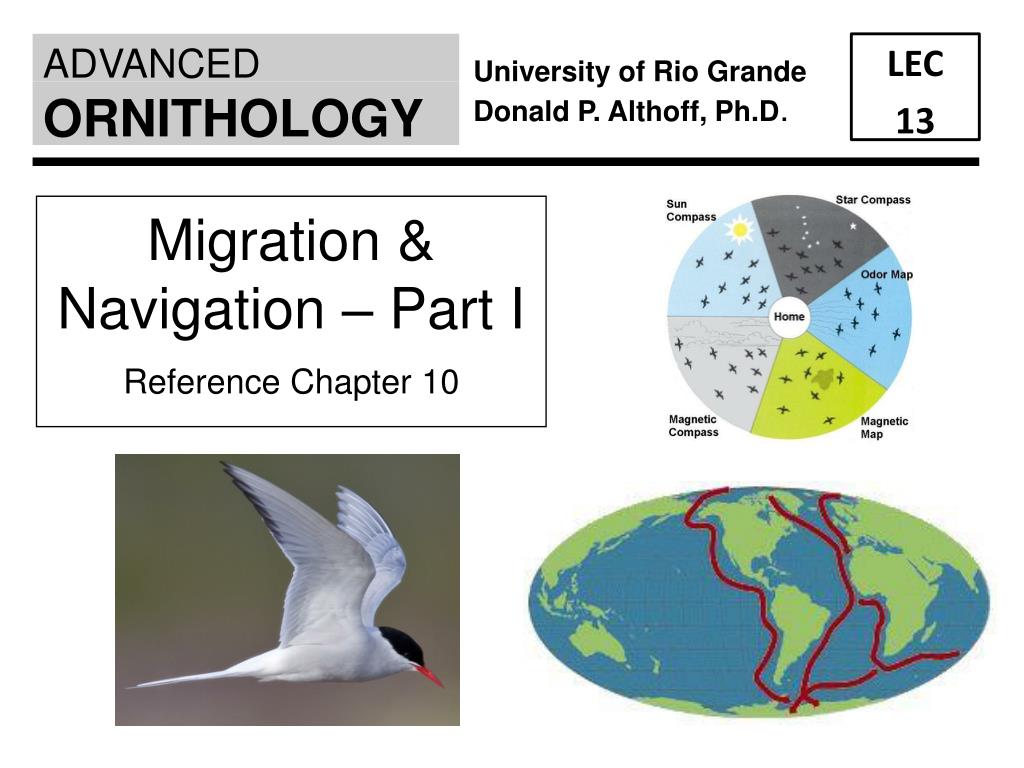
  1. ADVANCED LEC 13 University of Rio Grande Donald P. Althoff, Ph.D. ORNITHOLOGY Migration & Navigation – Part I Reference Chapter 10

  2. From Here to There…and Back Again “Bird migration is the world’s only true unifying natural phenomenon, stitching the continents together in a way that even the great weather systems fail to do” Weidensaul 1999

  3. Gill Fig 10-1,pg 275

  4. _________—shortest distance one-way between winter and summer ranges is _________ miles ! ! ! ! !

  5. Migration • For many species of birds, migration is a _______ part of the annual cycle • ___________________________________ guide the preparation for migration and the migratory behavior itself • Ultimate factors such as weather and food availability trigger day-to-day departures and stops to refuel

  6. Ultimate factors WEATHER COMPETITION FOOD LIGHT (or other) Proximate factors Migratory Restlessness = “__________” Hypothalamus Anterior pituitary MIGRATION Deposition of Subcutaneous fat layer

  7. Migration • LIGHT (or other) proximate factor—increasing photoperiod has tremendous impact on breeding cycle. Increase in light with increase in heat can bring this about. • The annual pattern of daylight changes (i.e., lengthening of daylight during the spring) is considerably ___________________ from year-to-year than the “spring warmup”.

  8. Migratory Restlessness • The German term for this is Zugunruhe. That term still sticks because if was first identified in captive, cage “wild” birds by German behavioral biologists. It is a compound word that consists of “Zug” = ________________ and “unruhe” = _____________________. • Migratory species (populations) exhibit this, a few non-migratory species do. The non-migratory species that do are said to exhibit _________ = tendency to revert back to ancestral type. This would suggest there is a ______________ for some migratory behavior responses

  9. Tropical Species • Some show no refractory period (i.e., no resistence to being stimulated) • Research on common weaver birds (found in Africa)—when kept on a 15-hour light cycle—showed in peak breeding condition

  10. ___________________ Migration example • Some species must “learn” the migration routes. This would be evident in species that would tend to flock together during migration. • Example of trying to rear in captivity—then release into the wild—__________cranes: had to have ultra-light “mom”—who had been _____________ on them shortly after hatching show themmigration route http://www.youtube.com/watch?v=b-CRFT_Pvm4

  11. Culturally-based migration SANDHILL CRANES

  12. ______________ of PHOTOPERIOD alone explaining migration: • Operates principally in birds in ____________ latitudes, less so in tropical species • Increased light cannot initiate migration in ________________ migrants • ____________ migrations have no correlation with day length

  13. Some are TRANSEQUATORIAL… Most birds that migrate go to the “tropics” and tssentially stay in one hemisphere Breed in northern hemisphere Equator Migrate to southern temisphere for winter

  14. __________ of Light on NON-equatorial species • TSH  Thyroid  Thyroxin  Molt (TSH = thyroid stimulating hormone) • FSH  Gonadal recrudescence  Ovulation or sperm formation (FSH = follicle stimulating hormone) • LH  Follicle or interstitial cells  Sex hormones  songs, displays, soft part color enhancement, etc. (LH = lutenizing hormone)

  15. TSH thyroid FSH LH thyroxin gonadal recrudescence molt follicle or interstitial cells sex hormones ovulation or sperm formation songs, displays, soft part coloration, etc.

  16. Time of Day Times of migration as determined by radar • Much migration goes on _______________—especially among small birds (i.e, songbirds) and waterfowl. This may be due to celestrial clues • Hawks migrate more during the day to take advantage of _________. % Activity fall spring Noon Sunset Noon Sunrise Midnight

  17. Altitude of Migration • Most birds fly just ________ the clouds • Higher altitude may be response to be “air-cooled” in order to ________________ as a result of _________, which gives off much heat. Thus, most birds appear to select altitudes with 10oC (50oF) or less temps Altitude Stop Start Distance

  18. Altitude of Migration 10, 000 night Height (ft) 5,000 day 0 % of birds

  19. Other Influences… • Influence of ______—tail winds would be most advantageous • _________________ • More migration (on average) during _________ • __________________

  20. Influence of wind low high • Lows rotate counterclockwise • Highs rotate clockwise • _____________________  peak movements during the fall. • _____________________  peak movement during the spring warm front high low warm front

  21. Migration Potpourri • About equal distances traveled each night (day) during migration if weather is favorable • Most birds ______________________ (most passerines under 3,000 ft.) • Most large birds migrate in higher winds, passerines in slower winds • Some species may _____________ of migration route if encounter forminable/daunting weather conditions on way to breeding grounds. Example: snow geese

  22. Sandhill Cranes: mid-continent populations

  23. Sandhill Cranes – _____________________area over 500,000 birds stop for 3-4 weeks

  24. Migration Patterns – eBird_______Science • Dickcisselhttp://ebird.org/content/ebird/occurrence/dickcissel/ • Scarlet Tanager http://ebird.org/content/ebird/occurrence/scarlet-tanager/ • White-throated sparrow http://ebird.org/content/ebird/occurrence/white-throated-sparrow/ • Common Yellowthroat http://ebird.org/content/ebird/occurrence/common-yellowthroat/ • Yellow-billed cuckoo http://ebird.org/content/ebird/occurrence/yellow-billed-cuckoo/

  25. _____________ Migrants ______in North America ______ in Central and/or South America

  26. Types of Migration • __________ migration—just discussed • __________ migration—rare • __________ migration—mt. quail, ptarmigan • __________ migration—Heerman’s gull, California gull • __________ migration--shearwater

  27. Types of Migration…con’t • _________________ migration • Sandhill crane migration (as noted…mid-migration staging) • _________________—fox sparrows and song sparrows (by species) • Etc. ptarmigan—by sex: males go further south than females • We’ve learned much about bird migrations via: a) ______________________ b) ______________________ c) ______________________