Classical India
This chapter explores the intricate geography and formative cultural periods of Classical India, highlighting the significance of its diverse landscapes and monsoon climate in shaping regionalism and agricultural practices. It traces the evolution of key cultural traits during the Vedic and Epic Ages, emphasizing the caste system and polytheistic beliefs. Additionally, the transition from the Mauryan Empire to the Gupta Empire showcases the dynamics between regionalism and centralization. Finally, the chapter addresses the emergence of Hinduism and Buddhism, including their beliefs, practices, and impact on art, science, and trade.

Classical India
E N D
Presentation Transcript
Classical India Chapter 3 Pg. 56-74
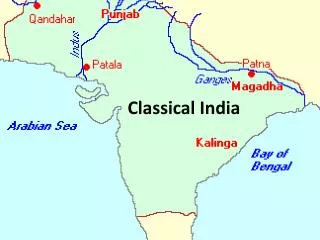
1 of 2 Geography & Formative Period • Geography • Well positioned for trade • Diverse landscape results in regionalism • Monsoon climate • Heavy summer rains during June, July, August • Dry season with almost no rain from Sept to May • Extreme impacts on agriculture
2 of 2 Geography & Formative Period • Formative Periods • Vedic Age (1500-1000 BCE) • Epic Age (1000-600 BCE) • Resulted in creation of early forms of key cultural traits: • caste system • polytheistic religion
Patterns in Classical India • 1500-600BCE: Vedic & Epic Ages • 600-322BCE: Regional states dominate plains • 322-232BCE: Mauryan Empire • Autocratic rule, Buddhist • 232BCE-320CE: Regionalism reemerges (Kushans) • 320-535CE: Gupta Empire • Decentralized rule, Hindu
Political Institutions • Most persistent political feature of India is regionalism • However, some centralization did occur • Example: Gupta promotion of Sanskrit & law code • Caste system provided local control & regulation often fulfilled by gov
Question Even though the Maurya and Gupta empires were highly influential, Indian history largely is characterized by small regional kingdoms. • Why do you think large empires did not "take hold" in India as they did in other parts of the world? • What is unusual or significant about Indian culture in this respect?
1 of 4 Religion & Culture • Hinduism evolved overtime yielding remarkable complexity & diversity • Forms of Worship: • Ritualistic, ceremonial worship (brahmins) • Mystical search for divine essence (gurus) • Belief structure:
2 of 4 world of humans: dharma fulfillment of life roles karma reincarnation death Brahma Vishnu Shiva millions of local deities
3 of 4 Religion & Culture • Buddhism founded by Siddartha Gautama in 536 BCE in response to Hinduism • Questioned fairness of misery believing the material world caused human suffering • Adopted Hindu ideas of mysticism & reincarnation; • Rejected caste, rituals, priests
4 of 4 Religion & Culture • Art & Science flourished in Indian culture • Literature: • Science: • Math: • Art:
Economy & Society • Caste system & agriculture provided basic framework of hierarchy • Patriarchal but with greater emotional ties to women & children • Economy firmly subsistence agriculture but with significant trade & manufacturing • Key good = cotton textiles • Merchants valued
Indian Influence • Indian Ocean was the key linkage among cultures • Trade carried Indian creativity, goods, religions from Africa & Middle East to SE Asia • Buddhism, Hinduism, Art to SE Asia • Buddhism, Art to China
India & China • Differences: • Similarities:
Global Connections • Indian civilization was pivotal to cultural exchange largely through Indian Ocean & Silk Road
Question • Explain how … • Hinduism changed and stayed the same between 1500 BCE and 535 CE • Buddhism changed and stayed the same between 536 BCE and 535 CE