Understanding Simplex, Hyper-Cube, and Convex Hull: Volumes and Determinants in Multi-Dimensional Spaces
280 likes | 460 Vues
This lecture explores the concepts of Simplex, Hyper-Cube, and Convex Hulls in multi-dimensional spaces. It explains linear combinations, affine combinations, and convex combinations of vectors, leading to the definition of n-dimensional Simplex as the set of convex combinations of n+1 affinely independent vectors. Moreover, it details the properties and computations related to the volumes of pseudo-hypercubes, determinants of square matrices, and their significance in determining invertibility and transformation properties. Essential for students of linear algebra and geometry.


Understanding Simplex, Hyper-Cube, and Convex Hull: Volumes and Determinants in Multi-Dimensional Spaces
E N D
Presentation Transcript
Lecture 14Simplex, Hyper-Cube, Convex Hull and their Volumes Shang-Hua Teng
Linear Combination and Subspaces in m-D • Linear combination of v1(line) {c v1: c is a real number} • Linear combination of v1and v2(plane) {c1v1 + c2v2: c1 ,c2are real numbers} • Linear combination of n vectors v1 , v2 ,…, vn (n Space) {c1v1 +c2v2+…+ cnvn: c1,c2 ,…,cnare real numbers} Span(v1 , v2 ,…, vn)
Convex Combination in m-D p1 y p2 p3
Simplex n dimensional simplex in m dimensions (n < m) is the set of all convex combinations of n + 1 affinely independent vectors
Hypercube (1,1,1) (0,1) (0,0,1) (1,0,0) (1,0) n-cube
Pseudo-Hypercube or Pseudo-Box n-Pseudo-Hypercube For any n affinely independent vectors
Convex Set A set is convex if the line-segment between any two points in the set is also in the set
Non Convex Set A set is not convex if there exists a pair of points whose line segment is not completely in the set
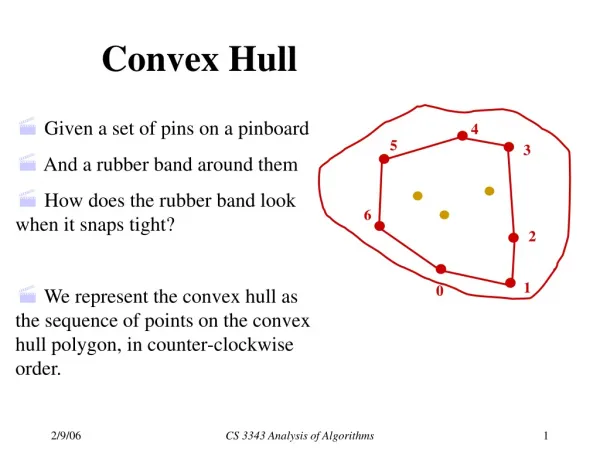
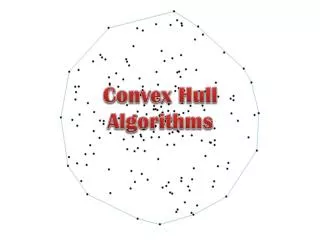
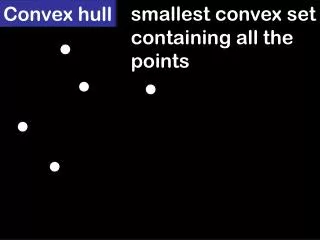
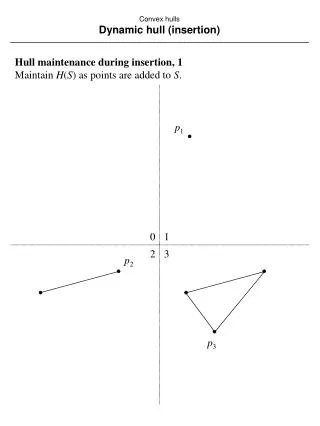
Convex Hull Smallest convex set that contains all points
Volume of Pseudo-Hypercube n-Pseudo-Hypercube For any n affinely independent vectors
Signed Area and Volume p2 (0,0) p1 volume( cube(p1,p2) ) = - volume( cube(p1,p2) )
Determinant of Square Matrix How to compute determinant or the volume of pseudo-cube?
Determinant in 2D p2 =[b,d]T Why? (0,0) p1 =[a,c]T Invertible if and only if the determinant is not zero if and only if the two columns are not linearly dependent
Determinant of Square Matrix How to compute determinant or the volume of pseudo-cube?
Properties of Determinant • det I = 1 • The determinant changes sign when sign when two rows are changed (sign reversal) • Determinant of permutation matrices are 1 or -1 • The determinant is a linear function of each row separately • det [a1 , …,tai ,…, an] = t det [a1 , …,ai ,…, an] • det [a1 , …, ai+ bi ,…, an] = det [a1 , …,ai ,…, an] + det [a1 , …, bi ,…, an] • [Show the 2D geometric argument on the board]
Properties of Determinant and Algorithm for Computing it • [4] If two rows of A are equal, then det A = 0 • Proof: det […, ai ,…, aj …] = - det […, aj ,…, ai …] • If a= aj then • det […, ai ,…, aj …] = -det […, ai ,…, aj …]
Properties of Determinant and Algorithm for Computing it • [5] Subtracting a multiple of one row from another row leaves det A unchanged • det […, ai ,…, aj - tai …] = det […, ai ,…, aj …] + det […, ai ,…, - tai …] • One can compute determinant by elimination • PA = LU then det A = det U
Properties of Determinant and Algorithm for Computing it • [6] A matrix with a row of zeros has det A = 0 • [7] If A is triangular, then • det [A] = a11 a22 …ann • The determinant can be computed in O(n3) time
Determinant and Inverse • [8] If A is singular then det A = 0. If A is invertible, then det A is not 0
Determinant and Matrix Product • [9] det AB = det A det B (|AB| = |A| |B|) • Proof: consider D(A) = |AB| / |B| • (Determinant of I) A = I, then D(A) = 1. • (Sign Reversal): When two rows of A are exchanged, so are the same two rows of AB. Therefore |AB| only changes sign, so is D(A) • (Linearity) when row 1 of A is multiplied by t, so is row 1 of AB. This multiplies |AB| by t and multiplies the ratio by t – as desired.