Overview of Cranial Nerves and Their Functions
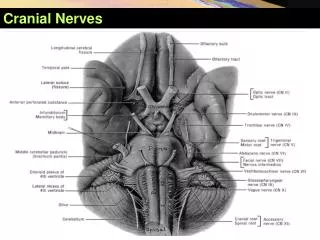
Cranial nerves are essential for sensory and motor functions in the head and neck. This comprehensive overview highlights the twelve cranial nerves, detailing their specific roles. The Olfactory nerve is responsible for the sense of smell, while the Optic nerve is crucial for vision. Other key nerves include the Oculomotor and Trochlear, which control eye movements; the Trigeminal nerve, which mediates touch sensations and chewing; and the Facial nerve, responsible for facial expression and taste. Notably, the Vagus nerve influences swallowing, and the Hypoglossal nerve governs tongue movements.

Overview of Cranial Nerves and Their Functions
E N D
Presentation Transcript
Cranial Nerves • Serve head or neck
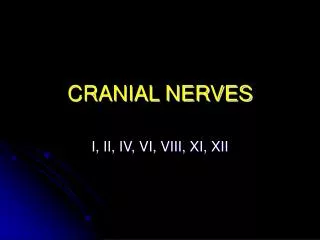
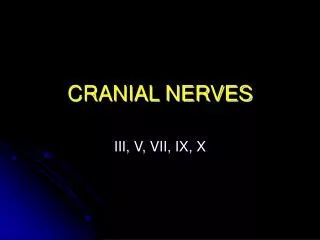
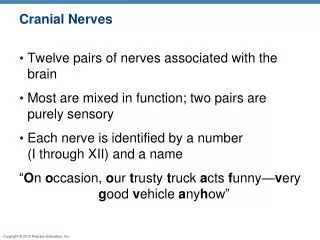
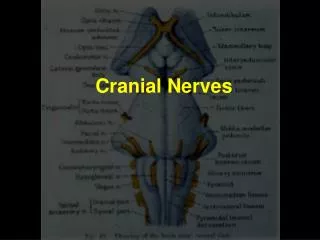
Cranial Nerves Cont. • Olfactory- sense of smell • Optic- vision • Oculomotor- muscles of the eye • Trochlear- motor for one eye muscle • Trigeminal- sense of touch and temp, muscles of chewing • Abducens- look side to side • Facial- muscles of the face, taste • Vestibulocochlear- sense of balance and hearing • Glossopharyngeal- swallowing, taste
Cranial Nerves cont • Vagus- similar to glossopharyngeal • Accessory- motor control sternocleidomastoid and trapezius muscles • Hypoglossal- tongue movements and sensory