Download
1 / 12
120 likes | 253 Vues
Join our upcoming lectures to explore molecular shapes, Lewis structures, and chemical bonding theories. Topics include VSEPR theory, bond enthalpies, hypervalent molecules, and violating the octet rule. Prepare for exams by studying chapters 8 and 9.

E N D
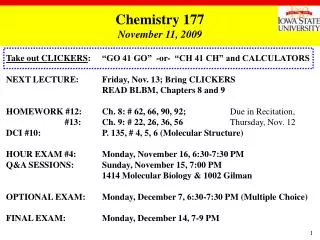
Chemistry 177 November 11, 2009 Take out CLICKERS: “GO 41 GO” -or- “CH 41 CH” and CALCULATORS NEXT LECTURE:Friday, Nov. 13; Bring CLICKERS READ BLBM,Chapters 8 and 9 HOMEWORK #12: Ch. 8: # 62, 66, 90, 92; Due in Recitation, #13:Ch. 9: # 22, 26, 36, 56 Thursday, Nov. 12 DCI #10: P. 135, # 4, 5, 6 (Molecular Structure) HOUR EXAM #4: Monday, November 16, 6:30-7:30 PM Q&A SESSIONS: Sunday, November 15, 7:00 PM 1414 Molecular Biology & 1002 Gilman OPTIONAL EXAM: Monday, December 7, 6:30-7:30 PM (Multiple Choice) FINAL EXAM: Monday, December 14, 7-9 PM
Chapter 8: Basic Concepts of Chemical Bonding Molecular Geometry:Lewis Structures (Violating the Octet Rule) Phosphorus Pentafluoride: PF5 F 5 BOND PAIRS F “Hypervalent” Molecules P violates the octet rule by being surrounded by more than 8 valence electrons (4 electron pairs). F P F 15 LONE PAIRS F 5 + 5(7) = 40 e (20 e pairs) Formal Charges: P: 5 (0 + 51) = 0 F: 7 (32 + 11) = 0
CO2: 5 DOMAINS PF5: 2 DOMAINS BF3: 3 DOMAINS SF6: 6 DOMAINS 4 DOMAINS NH3: Chapter 9: Molecular Geometry and Bonding Theories Molecular Shapes: VSEPR + Lewis Structures Valence Shell Electron Pair Repulsion: What are the shapes of molecules? Determine the local structure at an atom in a molecule or solid; Count the regions of electron-pairs around an atom: Single bonds, Lone Pairs, Multiple Bonds (Single Domain) Examples: (Use Lewis Structures)
Chapter 9: Molecular Geometry and Bonding Theories Molecular Shapes: VSEPR + Lewis Structures
4 BOND Pairs/1 LONE Pair OR AXIAL Ligands 90 EQUATORIAL Ligands 120 164.6 pm 154.5 pm Feq-S-Feq = 101.6 Fax-S-Feq < 90 Fax-S-Fax = 173.1 S-Feq = 154.5 pm; S-Fax = 164.6 pm Fax-Cl-Feq = 87.5 Fax-Cl-Fax = 175 Cl-Feq = 159.8 pm; Cl-Fax = 169.8 pm Chapter 9: Molecular Geometry and Bonding Theories Molecular Shapes: VSEPR (Trigonal Bipyramid) 157.7 pm 153.4 pm Feq-P-Feq = 120 Fax-P-Feq = 90 Fax-P-Fax = 180 P-Feq = 153.4 pm; P-Fax = 157.7 pm
Chapter 9: Molecular Geometry and Bonding Theories Molecular Shapes: VSEPR + Lewis Structures
4 BOND Pairs/2 LONE Pairs 5 BOND Pairs/1 LONE Pair Fax-Br-Feq = 84 Br-Feq = 180 pm; Br-Fax = 168 pm Chapter 9: Molecular Geometry and Bonding Theories Molecular Shapes: VSEPR (Octahedron)
Chapter 8: Basic Concepts of Chemical Bonding Molecular Geometry:Lewis Structures (Violating the Octet Rule) Hypovalent Molecules Hypervalent Molecules OCTET RULE
CH4(g) H(g) + CH3(g); DH0 = D(HCH3) = 427 kJ/mol CH4(g) C(g) + 4 H(g); DH0 = 1660 kJ/mol = 4 (415 kJ/mol) D(CH) = 413 kJ/mol AVERAGE over many molecules Chapter 8: Basic Concepts of Chemical Bonding Bond Enthalpies = Bond Dissociation Energies DH0 for reactions involving molecular species can be well estimated using average bond enthalpies for chemical bonds in the molecules… Bond Enthalpy = Enthalpy change (in kJ) to homolytically break a (polar) covalent bond (Tabulated…) Cl2(g) 2Cl(g); DH0 = D(ClCl) = 242 kJ/mol (bonds) HCl(g) H(g) + Cl(g); DH0 = D(HCl) = 431 kJ/mol
Chapter 8: Basic Concepts of Chemical Bonding Bond Enthalpies DH0 REACTANTS PRODUCTS N2(g) + 3 H2(g) 2 NH3(g) (1) (2) REACTANTS GASEOUS ATOMS PRODUCTS
HCCH HOH O=O O=C=O 413 kJ 839 kJ 495 kJ 799 kJ 463 kJ Chapter 8: Basic Concepts of Chemical Bonding Bond Enthalpies Example: Use average bond enthalpies to estimate the enthalpy of combustion of acetylene gas, C2H2(g). 2 C2H2(g) + 5 O2(g) 4 CO2(g) + 2 H2O(g) DH0= 2511 kJ
Chapter 8: Basic Concepts of Chemical Bonding Molecular Geometry:Lewis Structures (Violating the Octet Rule) Nitrogen Dioxide: NO2 O N O O N O