Integrating Support Frameworks for Students with Disabilities and Challenging Behaviors
260 likes | 377 Vues
This comprehensive framework aims to support students with disabilities and challenging behaviors through applied behavior analysis. It emphasizes community presence, autonomy, and continuous skill development to enhance independence and productivity. The approach prioritizes proactive strategies that focus on understanding and addressing the purpose behind behaviors, instead of relying on punishment. Key interventions involve ecological adjustments, positive programming, and effective behavioral assessment to create a supportive environment for learners. The model fosters social relationships and values individual choice, promoting a fulfilling educational experience.


Integrating Support Frameworks for Students with Disabilities and Challenging Behaviors
E N D
Presentation Transcript
A framework for Supporting Students with Disabilities and Challenging Behaviour: From Theory to Practice
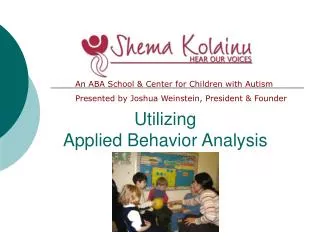
The Institute for Applied Behavior Analysis
Technology in Support of Values - Social Role Valorisation • Community presence and participation, in ways that are age appropriate and valued by society. • Autonomy and self determination, through the exercise of increasingly informed choice. • Continuous involvement in the ongoing process of becoming. • Increasing independence and productivity, to the point of economic self sufficiency. • The opportunity to develop a full range of social relationships and friendships.
Definition of Challenging Behaviours Cultural abnormal behaviour(s) of such intensity, frequency or duration that: • The physical safety of the person or others is likely to be placed in serious jeopardy. • Behaviour is likely to seriously limit use or result in the person being denied access to ordinary community facilities. (Emerson, 1995)
Punishment • Type 1: The contingent PRESENTATION of a stimulus or event, resulting in a FUTURE decrease in response strength. • Type 2: The contingent WITHDRAWAL of a stimulus or event, resulting in a FUTURE decrease in response strength.
Aversive • A stimulus or event one would ordinarily act to avoid. Not all aversive acts are punishment.
Why use alternatives to punishment? • Legislation • Court findings • Agency Policies • Danger of elicited and evoked aggression • Lack of social validity • May not produce durable outcomes • Punishment is an after-the-fact procedure • Ethical considerations
Basic Assumptions of the IABA model • Problem behaviour is purposeful. • Assessment is necessary to identify the purpose the behaviour serves for the person. • Intervention is about enhancing the student’s skills NOT just reducing behaviours. • Challenging behaviours often serve more than one purpose and therefore require multiple interventions. • Intervention is about changing social systems. • Enhancing student’s lifestyles is the ultimate goal of intervention.
The Goals of Intervention • To diffuse the immediate situation - REACTIVE STRATEGIES. • To decrease the likelihood of future incidents - PROACTIVE STRATEGIES.
Define Target Behaviour Gather Information Synthesise Information Analyse the meaning of the behaviour Formulate a working hypothesis Devise Intervention Plan
Assessment • Goal: Understand the nature of the behaviour so that the most effective interventions can be identified. • Identify variables that predict the behaviour is more or less likely to occur. • Function that the behaviour serves for the person.
The Process • Records review, e.g. NEP, SDP. • Interview stakeholders. • Direct observation and interaction. • Hypothesis testing.
Materials • Behaviour Assessment Guide • Motivation Assessment Scale • Reinforcement Inventories • Questionnaires • Data collection proforma
Assessment is only useful if we: • SYNTHESISE THE INFORMATION • ANALYSE THE MEANING OF THE BEHAVIOUR • FORMULATE A WORKING HYPOTHESIS
5 Hypotheses • To initiate or maintain social contact. • To escape or avoid non-preferred activities, situations, events and people. • To obtain preferred objects, activities or events. • To express emotions or reduce stress. • To obtain or withdraw from sensory stimulation.
Implementing Strategies • PROACTIVE STRATEGIES • Ecological Strategies (changes to the environment,, instructions/interactions, program) • Positive Programming (developing the learner’s skills and competencies) • Focused Support (gaining temporary control of the behaviour while implementing the ecological and positive program strategies)
Reactive Strategies Dealing with low level violence – swearing, verbal abuse and threatening gestures The 4D’s approach – defuse, deflect, defer and deal with. Responding to a crisis Get out of the way! Remove the learner/the class Use of restraint – only in exceptional circumstances! Paperwork Debrief LOOK AFTER YOURSELF!!!
Common Questions about the Model • Is the model resource intensive? • Is a Comprehensive Functional Assessment required for all students with challenging behaviours? • How does this fit with the School Discipline/Early Childhood Behaviour Management Policies? • The model is non-aversive so how do we protect staff/students? • Does it work?