Phases of Matter and Phase Changes
340 likes | 489 Vues
This guide explores the phases of matter: solids, liquids, and gases, detailing their unique properties and how they change from one phase to another. Solids maintain a definite shape and volume with tightly packed particles, while liquids have a definite volume but no fixed shape, allowing particles to slide past each other. Gases have neither a definite shape nor volume, expanding to fill their container. Furthermore, the guide covers phase changes like melting, vaporization, and sublimation, alongside concepts of energy, temperature, and heat flow.


Phases of Matter and Phase Changes
E N D
Presentation Transcript
Phase • Depends on strength of forces of attraction between particles. .
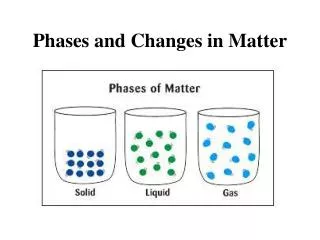
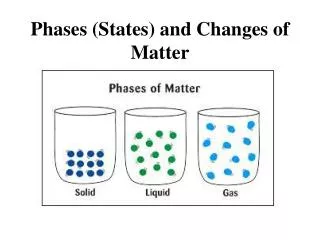
Solids • Definite shape, volume. • Regular crystalline lattice structure. • Most dense phase (exception is water!). • Difficult to compress. • Highest attraction between particles. • Atoms vibrate in fixed positions • Note: Amorphous solids include glass, plastic, wax, and silly putty
Liquids • Definite volume • No definite shape • Hard to compress • Particles can slide past each other • Forces of attraction between particles still high
Gases • No definite shape or volume • Expands to fill container • Lowest density • Density depends on pressure • Little attraction between particles • “Vapor” = a gaseous state of something that is normally liquid (Ex: water vapor)
Phases Applet • Short Summary video on phases: • http://www.youtube.com/watch?v=s-KvoVzukHo&safe=active • http://www.harcourtschool.com/activity/states_of_matter/
Changes in Phase Gas Condensation Vaporization (Boiling or Evaporating) Liquid Solidification Melting (fusion) Solid
Let’s Skip a Phase • Sublimation • Directly from the solid phase to the gas phase. • Happens with substances with weak intermolecular forces of attraction • They separate easily! • Ex: CO2(s) dry ice, Iodine CO2(s) → CO2 (g) http://www.youtube.com/watch?v=J8mDGwf-5x0&safe=active
Energy • Energy = capacity to do work or produce heat. It can be anything that causes matter to move or change direction. • Ex: electrical, radiant, atomic, mechanical, magnetic, sound, chemical • Energy and the 4 states of matter: • http://www.youtube.com/watch?v=88tK5c0wgH4&safe=active
Law of Conservation of Energy • Energy can’t be created or destroyed, just transferred from one form to another
PE vs. KE • Potential Energy stored energy • Energy can be stored in bonds between atoms and released during chemical rxns. • Kinetic Energy energy of motion • All atoms are moving and vibrating unless at absolute zero
Heat Energy • A form of energy that increases the random motion of particles • Measured in Joules or calories. http://www.youtube.com/watch?v=f1eAOygDP5s&safe=active
Heat Flow • Heat energy travels from an object of higher temp. to one of lower temp. until both reach the same temp.
Temperature • Measure of the average kinetic energy (motion) of all the particles in a sample. • Not a form of energy!!! • But if you add heat energy or take it away, it causes particles to move faster or slower and thus changes the temp.
Temperature Scales Used in Chemistry Celsius • Fixed points of scale based on the freezing point and boiling point of water • 0 °C = water freezes, 100 °C = water boils Kelvin • Scale based on lowest temperature possible • 0 K = absolute zero
Absolute Zero • Temperature at which particles have slowed down so much they no longer possess any kinetic energy. 0 Kelvin -273° Celsius
Heat vs. Temperature • Teacup vs. Bathtub • Both at 25˚C • Which one contains more heat energy? • Which one has the greater average KE?
Exothermic vs. Endothermic • All changes in matter are accompanied by changes in energy. • Exothermic Change:A + B → C + D + energy • Energy is released • Energy “ex”its • Endothermic Change:A + B + energy → C + D • Energy is absorbed • Energy “en”ters
Energy During Phase Changes • Endothermic: (s→l, or l→g) • Energy overcomes attractive forces between particles • PE increases • Exothermic: (g→l, or l→s) • As particles come closer together energy is released • PE decreases
Heating & Cooling Curves • Graphically represents temp. changes as heat energy is added or taken away.
The slanted portions = temp is changing Single phase is heating up or cooling down KE is changing The flat portions = temp not changing Substance undergoing a phase change PE is changing Interpreting the Graph • http://mutuslab.cs.uwindsor.ca/schurko/animations/waterphases/status_water.htm
Heat Equations • Calculates the energy involved when a substance changes in temperature or undergoes a phase change.
Physical Constants for WaterTable B Use these constants in Heat Equations Hf = heat of fusion = 334J/g Hv = heat of vaporization = 2260J/g Specific Heat Capacity (“c”) = 4.18 J/g x K
What is Specific Heat Capacity? Specific Heat: Joules of heat needed to raise 1 gram of a substance 1°C. • Substances have different abilities to absorb heat when energy is applied depending on their composition. Ex: Piece of Iron vs. Water.
When Undergoing Phase Change (Temp. constant) use one of these formulas: • Q = mHf Use when changing from solid to liquid (melting) or liquid to solid (freezing) • Q = mHv Use when changing from liquid to gas (vaporization) or gas to liquid (condensing)
Calorimeters • Instrument used to determine amount of heat lost or gained in a reaction by measuring changes in the temp. of water surrounding the system. Q = mcΔT
Multi-step Heat Problems (Honors) • Need to use more than one of the heat equations and add up the total heat. • Ex: Calculate the heat energy to raise 10 grams of water at -25°C to 80°C. • Draw a heating curve. Figure out # of steps. • 1.) Heat ice from -25° to 0° q = mcΔT • 2.) Melt ice to liquid at 0° q = mHf • 3.) Heat liquid water from 0° to 80° q = mcΔT
Heat Lost = Heat Gained (Honors) • When two objects of different temperatures are placed together in a closed system, heat will flow from the hotter to the colder object until they reach the same temperature. • The total heat lost = total heat gained mcΔT = mcΔT