Understanding Phases & Changes in Matter
Explore the physical and chemical properties of matter, such as solids, liquids, and gases, and their phase changes like melting, freezing, and evaporating. Learn about density, solutions, and the differences between physical and chemical changes.


Understanding Phases & Changes in Matter
E N D
Presentation Transcript
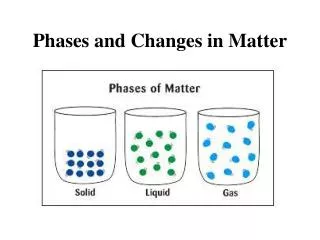
Solid • Has a definite shape and volume. Particles that make up a solid are packed together in relatively fixed positions and are held together by strong attractive forces between them.
Liquid • Has a definite volume but an indefinite shape (it assumes the shape of its container). Particles are close together but can move past one another. They move more rapidly than in a solid. This allows them to temporarily overcome the attractive forces and allows liquid to flow
Gas • Has neither a definite shape or volume. It will fill its container. Particles move very rapidly and are at great distances from each other. Attractive forces become very weak.
Physical Properties • Characteristics that can be observed or measured without changing the identity of the substance. They describe the substance. • Ex: Boiling point, Melting point
Physical Change • It does not involve a change in the identity of the substance. • Ex: Grinding, cutting, melting, boiling
Chemical Properties • Relates to a substance’s ability to undergo changes that transform it into different substances. • Easiest to see when substances react to form new substances. • Ex: Iron’s ability to rust, silver can tarnish when combined with sulfur
Chemical Change • Also known as a chemical reaction • A change in which one or more substances are converted into different substances.
Drawing of Physical Change Solid CO2 -> gaseous CO2
Drawing of Chemical Change FeO2 -> Fe + O2
Density • Density depends on how tightly the atoms/molecules are packed together
Gas – low density • The molecules are far apart; therefore, lots of volume
Liquid – higher density • Molecules are closer together, so density is higher
Solutions – higher density • Water molecules have other molecules “fitting” into spaces, increasing the mass for the same volume • This is why sugar and salt water are more dense than pure water
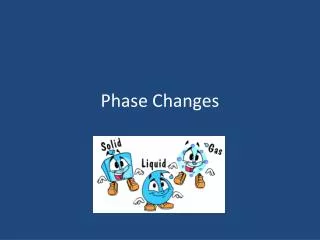
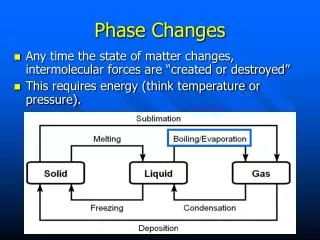
Phase Changes • Melting – changing from a solid to a liquid • Freezing – changing from a liquid to a solid • Evaporating – changing from a liquid to a gas • Condensing – changing from a gas to a liquid • Sublimation – changing from a solid to a gas • Deposition – changing from a gas to solid