Download
1 / 43
430 likes | 577 Vues
This comprehensive guide provides essential notes on DNA and protein synthesis, detailing the structures and functions of nucleic acids such as DNA and RNA. It explains nucleotides, genes, and the processes of replication, transcription, and translation. The guide also covers the differences between DNA and RNA, including their composition and structure. Additionally, it includes basic concepts of how genetic information is transferred from DNA to proteins, illustrating the significance of codons and tRNA in protein synthesis.

E N D
DNA and Protein Synthesis Notes January 4, 2011
Name of the molecule identified by the arrow: • Phosphate group • Nitrogen base • Adenine • Sugar
Name given to the circled structure: • Nucleic acid • Amino acid • Nucleotide • Nucleus
The type of reaction responsible for joining molecules A and B • Hydrolysis • Dehydration A B
Let’s assume the following strand of DNA contains the information needed to make a protein. This segment of DNA is known as a____: • Nucleotide • Codon • Translation • Gene • mRNA
Which is single stranded? • DNA • RNA
Which one can exit the nucleus? • DNA • RNA
The two strands of DNA are bonded together in the middle by their… • Sugars • Phosphates • Nitrogen bases
Which one contains nitrogenous bases A, T, G and C? • DNA • RNA
A. Function of Nucleic Acids • Control the processes of heredity by which cells and organisms reproduce proteins.
B. Types of Nucleic Acids • DNA: Deoxyribonucleic Acid • RNA: Ribonucleic Acid
C. Structure of Nucleic Acids • Made up of a chain of Nucleotides that contain • Phosphate backbone • Sugar • Nitrogen base • Guanine • Cytosine • Adenine • Thymine (Found only in DNA) • Uracil (Found only in RNA)
DNA SUGAR Phosphate
D. DNA vs. RNA • Sugar is Ribose • Has nitrogen base Uracil instead of Thymine • Also contains the other 3 bases • Only single stranded
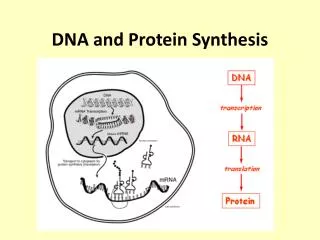
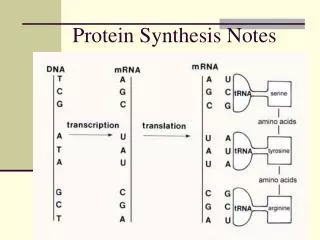
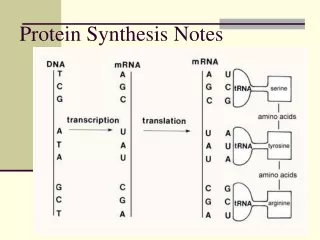
II. Protein Synthesis • It’s a process • DNA -> RNA -> Amino Acids (Protein)
Three processes in this unit… • Replication (DNA DNA) • Transcription (DNA mRNA) • Translation (RNA Protein)
A. DNA Replication • Occurs in the nucleus prior to any cell division • Enzyme is used to “unzip” or “unwind” the DNA • Forms a bubble at the origin site
DNA Replication (cont.) • Another enzyme is used to build a complementary strand of DNA from the template piece of original DNA • Nitrogenous bases pair up • A – T • C - G • As a result, you create two identical strands of DNA
Let’s Practice • Replicate the following strand of DNA using the correct nitrogenous bases: ATCGGCTATTAGGCATATCCGACGGTC TAGCCGATAATCCGTATAGGCTGCCAG
B. Transcription • DNA strand unzips • The bonds between the nitrogen bases are broken • Initiated by RNA polymerase (enzyme) binding to promoter site on DNA • A single strand of mRNA (messenger RNA) is made • Pair up the bases • A U • T A • C G • G C • mRNA then travels from nucleus to cytoplasm
Where in the cell does transcription take place? • Cytoplasm • Mitochondria • Nucleus • Golgi Body • Vacuole
Any given segment of DNA has directions that make unique what? • Glucose • Proteins • Lipids • Blood cells
If a DNA strand has the following sequence of base pairs – A C T G G T C C A A , then the mRNA strand would have what sequence? • T G A C C A G G T T • A C T G G T C C A A • T G U C C U G G T T • U G A C C A G G U U
a. Why is mRNA called messenger RNA? • Because it carries the directions to make a protein to the ribosome like a message
4. Types of RNA • mRNA- messenger • Brings message from nucleus to ribosomes in cytoplasm • rRNA- ribosomal • Make up a ribosome • tRNA- transfer • “transfers” amino acids from the cytoplasm to the ribosome to be added to the chain
The difference between RNA and DNA is what? • The phosphates • The sugars • The nitrogen bases • The way the monomer units bond
mRNA is synthesized in the nucleus and travels to the cytoplasm to meet up with which organelle? • Mitochondria • Ribosome • Golgi Body • Lysosome • Nucleus
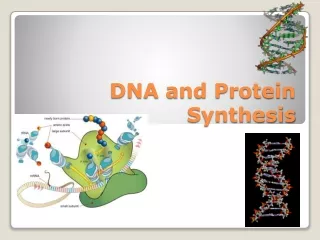
C. Translation • mRNA meets up with a ribosome…why?? • Function of ribosome is to be site for protein synthesis • tRNA molecules bring amino acids to ribosomes • An mRNA codon will pair with a tRNA anticodon • Codon: 3 Nitrogen base sequence in mRNA that specifies a specific amino acid • Anticodon: 3 Nitrogen base sequence in tRNA
Translation (cont.) • As tRNA’s are added, amino acids are bonded together and will be released as a fully functional protein.
How do you know what amino acids make up a particular protein? • We use an mRNA codon chart
Where in the cell does transcription, the first part of protein synthesis, take place? • Mitochondria • Nucleus • Ribosomes • Cytoplasm
DNA has the directions to make what? • Glucose • Nucleotides • Proteins • Monosaccharides
After a strand of mRNA is made where does it go? • Ribosome • Mitochondria • Lysosome • Vacuole
Where in the cell does translation, the second part of protein synthesis, take place? • Mitochondria • Nucleus • Golgi body • Cytoplasm
Molecules called tRNA’s are floating around the cytoplasm carrying what? • mRNA’s • Glucose • DNA • Nucleotides • Amino Acids
An mRNA codon is made up of how many nitrogen bases? • 1 • 3 • 6 • 24
Using your mRNA codon chart, what amino acid would a ribosome call for if the codon was A A C ? • Phenylalanine • Glutamine • Asparagine • Lysine • Tyrosine
What protein would be synthesized from the following mRNA strand?A C U U U C G A A U A C • Threonine – phenylalanine – glutamate – tyrosine • Phenylalanine – leucine – methionine – valine • Tyrosine – glutamate – phenylalanine – threonine • Lysine – cysteine – arginine – histidine
What protein would be synthesized from the following DNA segment?T A A G T A C G C T A G • Isoleucine – alanine – histidine – alanine • Isoleucine – histidine – alanine – isoleucine • Phenylalanine – leucine – valine – arginine • Isoleucine – leucine – threonine – lysine
How would you assess your comprehension of DNA & Protein Synthesis? • A • B • C • D