Download
1 / 1
20 likes | 146 Vues
In 1925, inspired by Wolfgang Pauli's insights, Ralph Kronig theorized the concept of electron spin, proposing that spin can point in two opposing directions, which creates a magnetic moment. Despite his innovative hypothesis, Kronig's experiments faced challenges, yielding results inconsistent with observations, leading to the rejection of his theory. However, Samuel Uhlenbeck and George Goudsmit later revived and expanded upon Kronig's work, incorporating relativistic corrections. Their contributions paved the way for significant advancements in understanding atomic structure and applications in technologies like MRI and Nuclear Magnetic Resonance.

E N D
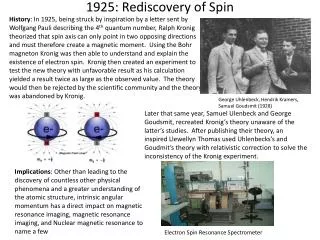
1925: Rediscovery of Spin George Uhlenbeck, HendrikKramers, Samuel Goudsmit (1928) Later that same year, Samuel Ulenbeck and George Goudsmit, recreated Kronig’s theory unaware of the latter’s studies. After publishing their theory, an inspired Llewellyn Thomas used Uhlenbecks’s and Goudmit’s theory with relativistic correction to solve the inconsistency of the Kronig experiment. History: In 1925, being struck by inspiration by a letter sent by Wolfgang Pauli describing the 4th quantum number, Ralph Kronig theorized that spin axis can only point in two opposing directions and must therefore create a magnetic moment. Using the Bohr magnetonKronig was then able to understand and explain the existence of electron spin. Kronig then created an experiment to test the new theory with unfavorable result as his calculation yielded a result twice as large as the observed value. The theory would then be rejected by the scientific community and the theory was abandoned by Kronig. Implications: Other than leading to the discovery of countless other physical phenomena and a greater understanding of the atomic structure, intrinsic angular momentum has a direct impact on magnetic resonance imaging, magnetic resonance imaging, and Nuclear magnetic resonance to name a few Electron Spin Resonance Spectrometer