Download
1 / 18
180 likes | 336 Vues
Many students struggle to connect physics to their daily lives, seeing it as irrelevant and detached from real-world experiences. This presentation aims to address these misconceptions by implementing problem-based learning strategies. We will explore various topics including kinematics and momentum through interactive experiments, such as the Rollercoaster Challenge. By creating engaging lessons that relate physics concepts to everyday life, we can improve student attitudes towards science and foster a deeper understanding of how the world works.

E N D
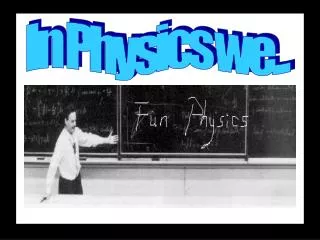
in Physics Problem-Based Learning Chris Meyer York Mills C.I. christopher.meyer@tdsb.on.ca www.meyercreations.com/physics
The Problem with Learning Many students do not believe science is real! Students don’t relate their ideas to their everyday life. Nonsense answers Science requires specialty equipment
CLASSColorado Learning Attitudes about Science Survey Real World Connections Category: The subject of physics has little relation to what I experience in the real world. Learning physics changes my ideas about how the world works. 76% → 53%
Kinematics • Frame a lesson
Kinematics • Frame the lesson • Develop the concepts and equations • Predict a result • Verify
Momentum Problem • Design an experiment • Take data • Analyze • Draw conclusions
Circular Motion • Develop ideas • A capstone question: What happens to the force of tension when the pendulum is swinging?
The Rollercoaster Challenge one metal bar
The Rollercoaster Challenge one metal bar
Force Concept Inventory (FCI) 82.8% 70 % York Mills 57% 1st Year PhysicsHarvard 1st Year Physics U of T Starting 1st year physics at U of T= 57% Starting 1st year physics at Harvard = 70% Finishing Gr. 12 physics at York Mills = 82.8%
Problem-Based Learning Uses: Motivation to develop ideas Confirm new ideas Apply ideas
Problem-Based Learning Results: must be immediately testable or verifiable must be verified by students not by authority figure can be found by direct experiments, comparisons to videos or simulations