Continuous Location and Density Prediction of Moving Objects on Road Networks
This study presents a novel approach for predicting the near-future locations and density of vehicles on road networks based on historical trajectories. Utilizing Closed Contiguous Frequent Routes (CCFR), the methodology performs real-time predictions of traffic conditions like density, speed, and flow. By employing effective knowledge representation and a depth-first search algorithm, the framework ensures accurate predictions while continuously mining relevant movement patterns. The empirical evaluation demonstrates real-time processing capabilities and accuracy improvements over traditional methods.

Continuous Location and Density Prediction of Moving Objects on Road Networks
E N D
Presentation Transcript
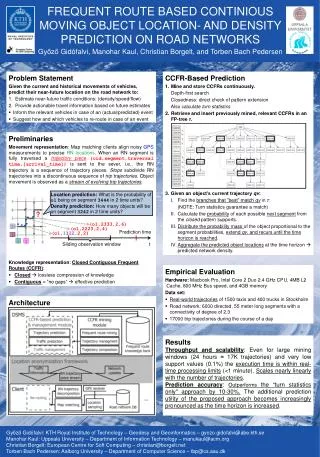
FREQUENT ROUTE BASED CONTINIOUS MOVING OBJECT LOCATION- AND DENSITY PREDICTION ON ROAD NETWORKS GyőzőGidófalvi, ManoharKaul, Christian Borgelt, and Torben Bach Pedersen CCFR-Based Prediction Mine and store CCFRs continuously. Depth-first search Closedness: direct check of pattern extension Also calculate turn statistics Retrieve and insert previously mined, relevant CCFRs in an FP-tree τ. 3. Given an object’s current trajectory qv: Findthe branches that ”best” match qvin τ. (NOTE: Turn statistics guarantee a match) Calculate the probability of each possible next segment from the closed pattern supports. Distribute the probability mass of the object proportional to the segment probabilities, extend qv, and recurs until the time horizon is reached. Aggregate the predicted object locations at the time horizon predicted network density. Problem Statement Given the current and historical movements of vehicles, predict their near-future location on the road network to: Estimate near-future traffic conditions: (density/speed/flow) Provide actionable travel information based on future estimates • Inform the relevant vehicles in case of an (actual/predicted) event • Suggest how and which vehicles to re-route in case of an event Preliminaries Movement representation: Map matching clients align noisy GPS measurements to precise RN locations. When an RN segment is fully traversed a trajectory piece(oid,segment,traversal time,[arrival_time]) is sent to the sever, i.e., the RN trajectory is a sequence of trajectory pieces. Stops subdivide RN trajectories into a discontinuous sequence of trip trajectories. Object movement is observed as a stream of evolving trip trajectories. Knowledge representation: Closed Contiguous Frequent Routes (CCFR): • Closed lossless compression of knowledge • Contiguous= ”no gaps” effective prediction Location prediction: What is the probability of o1 being on segment 3444 in 2 time units? Density prediction: How many objects will be on segment 3242 in 2 time units? ? Prediction time • (o1,2333,2,6) • (o1,2223,2,4) • (o1,1122,2,2) Sliding observation window t EmpiricalEvaluation Hardware: Macbook Pro, Intel Core 2 Duo 2.4 GHz CPU, 4MB L2 Cache, 800 MHz Bus speed, and 4GB memory Data set: Real-world trajectories of 1500 taxis and 400 trucks in Stockholm Road network: 6000 directed, 55 meter long segments with a connectivity of degree of 2.3 17000 trip trajectories during the course of a day Architecture Results Throughput and scalability: Even for large mining windows (24 hours ≈ 17K trajectories) and very low support values (0.1%) the execution time is within real-time processing limits (<1 minute). Scales nearly linearly with the number of trajectories. Prediction accuracy: Outperforms the “turn statistics only" approach by 10-30%. The additional prediction utility of the proposed approach becomes increasingly pronounced as the time horizon is increased. Győző Gidófalvi: KTH Royal Institute of Technology – Geodesy and Geoinformatics – gyozo.gidofalvi@abe.kth.se Manohar Kaul: Uppsala University – Department of Information Technology – manukaul@acm.org Christian Borgelt: European Centre for Soft Computing– christian@borgelt.net Torben Bach Pedersen: Aalborg University – Department of Computer Science – tbp@cs.aau.dk