Exploring Covalent Bonding with Bingo Chips: A Collaborative Learning Activity
In this engaging activity, students work together to create molecules such as NH3, Cl2, H2O, and CO using bingo chips to represent atoms. By utilizing the periodic table, they will determine the number of protons, neutrons, electrons, and valence electrons for each atom. The process includes sharing electrons to form covalent bonds and visually representing each molecule with specific colors for the electrons. Teamwork is essential, and each student is responsible for at least one atom, ensuring collaboration and learning about covalent vs. ionic bonds.

Exploring Covalent Bonding with Bingo Chips: A Collaborative Learning Activity
E N D
Presentation Transcript
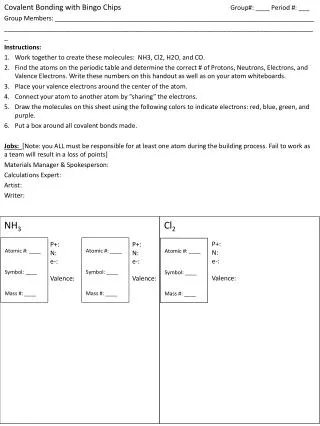
Covalent Bonding with Bingo Chips Group#: ____ Period #: ___ Group Members: _________________________________________________________________________ ________________________________________________________________________________________ Instructions: • Work together to create these molecules: NH3, Cl2, H2O, and CO. • Find the atoms on the periodic table and determine the correct # of Protons, Neutrons, Electrons, and Valence Electrons. Write these numbers on this handout as well as on your atom whiteboards. • Place your valence electrons around the center of the atom. • Connect your atom to another atom by “sharing” the electrons. • Draw the molecules on this sheet using the following colors to indicate electrons: red, blue, green, and purple. • Put a box around all covalent bonds made. Jobs: [Note: you ALL must be responsible for at least one atom during the building process. Fail to work as a team will result in a loss of points] Materials Manager & Spokesperson: Calculations Expert: Artist: Writer: NH3 Cl2 P+: N: e-: Valence: Atomic #: ____ Symbol: ____ Mass #: ____ P+: N: e-: Valence: Atomic #: ____ Symbol: ____ Mass #: ____ P+: N: e-: Valence: Atomic #: ____ Symbol: ____ Mass #: ____
H2O CO • Write a reflection (5 – 8 sentences) to answer the 2 questions below. Since each student should participate, assign one color to each team member. Underline what each person thinks in their color. • Red: Blue: Green: Purple: • What did you learn about covalent bonds? • How was this different than when we made ionic bonds (with beads)? Atomic #: ____ Symbol: ____ Mass #: ____ Atomic #: ____ Symbol: ____ Mass #: ____ P+: N: e-: Valence: P+: N: e-: Valence: Atomic #: ____ Symbol: ____ Mass #: ____ Atomic #: ____ Symbol: ____ Mass #: ____ P+: N: e-: Valence: P+: N: e-: Valence:


![K = [ NH 3 ] 2 = (0.031) 2 = 38000](https://cdn2.slideserve.com/4449941/slide1-dt.jpg)