Investigating NH3 and Its Role in Cometary Chemistry
This study explores the detection and significance of ammonia (NH3) in cometary ices, addressing its contribution alongside CO2 and H2O. The complex nitrogen chemistry within the early solar nebula remains poorly understood, particularly concerning N2, NH3, and their balance. By examining radio observations and analyzing spin temperatures inferred from ortho/para ratios, we propose insights into the formation conditions of these ices. Previous detections of NH3 in comets Halley and Hale-Bopp provide critical context for our findings and upcoming missions like the Rosetta lander.

Investigating NH3 and Its Role in Cometary Chemistry
E N D
Presentation Transcript
NH3 in comets Jennifer Hatchell (Exeter, ex-MPIfR) with Mike Bird (RAIUB) William Sherwood (MPIfR) Wilhelm Altenhoff (MPIfR) Floris van der Tak (MPIfR) Karl Menten (MPIfR)
Motivation - NH3 along with CO2 and H2O is a constituent of cometary ices. -Nitrogen chemistry in early solar nebula poorly understood (N2, NH3 and N balance) - Spin temperature (from ortho/para ratio) implies formation temperature of ices
Radio observations Photo: William Sherwood
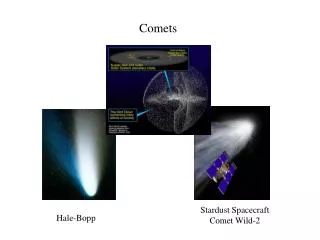
Previous radio detections NH3 /H2O C/1983 D IRAS-Araki-Alcock (Altenhoff et al. 1983) C/1996 B2 Hyakutake (Palmer et al. 1996, Green Bank) C/1995 O1 Hale-Bopp (Butler et al. 2002, Green Bank) C/1995 O1 Hale-Bopp (Hirota et al. 1999, Nobeyama) C/1995 O1 Hale-Bopp (Bird et al. 1997, Effelsberg) 6% 0.3% 1.8% 1.0-1.8% Direct detection Halley (Allen et al. 1987; Meier et al. 1994, Giotto) 0.1-2%
Optical detections of NH2 (daughter) OPR 3.33 Spin temp. 28K Spin temp. 30K NH3 /H2O = 0.5% C/1999 S4 LINEAR (Kawakita et al. 2001) C/1995 O1 Hale-Bopp & 153P/Ikeya-Zhang (Kawakita et al. 2004) Kawakita et al. 2002 reanalysis of earlier NH2 data Infrared detections of NH3 (lines often overlap with atmospheric absorptions) C/2002 T7 NH3 near 3 microns (Magee-Sauer et al. 2002) NH3 /H2O = ???
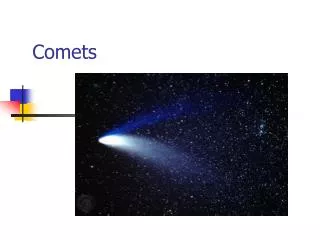
Targets 2001,2002,2004 C/2002 C1 (Ikeya-Zhang) (153P) C/2001 A2 (NEAT) 2002 2001 Images: T.Vsoske, T.Lovejoy, S.Kim, and M.Jäger/G.Rheman C/2001 Q4 (NEAT) C/2002 T7 (LINEAR) 2004
NH3 24 GHz NH3 /H2O <= 0.5%
Conclusions NH3 / H2O variable, 0.3-1.5% NH3 / H2O <= 0.5% in many comets: Halley and Hale-Bopp may have been exceptional Consistency between radio / optically derived ratios
Upcoming comet missions Deep Impact (NASA) 9P/Tempel 1 launch date Jan 12 2005 Impactor + cameras July 4 2005 Philae (lander) Rosetta (ESA) 67 P/Churyumov-Gerasimenko launched 2 March 2004 Lander 2014 Rosetta