Estimating NH3 Emissions and Deposition for European Policy-Making: A Dynamic Model Approach
This work-in-progress project focuses on the development of a dynamic NH3 atmospheric dispersion model to estimate ammonia (NH3) emissions and deposition across Europe. Utilizing a 50x50 km grid and high temporal resolution (3-hour intervals), the model integrates data from animal housing, manure storage, and field applications. By accounting for various sources and emissions factors, including meteorological conditions and structural input variables (e.g., animal numbers and types of housing), the results aim to support effective policy-making in addressing air quality and environmental health issues related to ammonia emissions.

Estimating NH3 Emissions and Deposition for European Policy-Making: A Dynamic Model Approach
E N D
Presentation Transcript
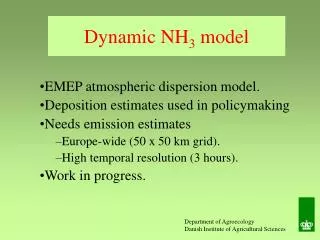
Dynamic NH3 model EMEP atmospheric dispersion model. Deposition estimates used in policymaking Needs emission estimates Europe-wide (50 x 50 km grid). High temporal resolution (3 hours). Work in progress.
Animal Animal housing Storage Field The model • Sources: • Housing. • Storage. • Field. • Mass flow model: • Ammoniacal N. • Organic N. • Dry matter. • Water. • Hourly timestep
NH3 H2O Animal housing Manure storage NH4+ Organic-N H2O Manure
NH3 H2O Field application NH4+ Organic-N H2O Manure Soil NH4+ H2O
Area of manure * Amount of NH4+ * Henry-factor Amount of water * Transport resistance NH3 emission
Area of manure * Amount of NH4+ * Henry-factor. Amount of water * Transport resistance Animal house emission Number of animals Floor area per animal Number of animals Urea-N per animal Temperature Manure pH Number of animals Volume per animal Ventilation rate Housing factor
Area of manure * Amount of NH4+ * Henry-factor. Amount of water * Transport resistance Animal house emission Number of animals Floor area per animal Number of animals Urea-N per animal Temperature Manure pH Number of animals Volume per animal Ventilation rate Housing factor = parameter
Parameterisation & testing • Lots of data. • Lots of time. • (see presentation on later today). • Temporary parameterisation using Dk emissions. • Synthetic weather data.
Ammonia emission (kg/day) 10 000 finishing pigs per 50 x 50km
Inputs • Meteorological e.g. • Daily temperature, rainfall, wind speed etc. • Structural (vary with location) e.g. • Number of animals. • Type of animal housing. • Operational (vary with time & location) e.g. • Housing dates and ventilation rates. • Manure application dates.
Structural input examples • For each animal type: • Animal numbers. • Ammoniacal-N and organic N excreted per animal. • Housing/storage type. • Dairy cattle.
Animal numbers • EUROSTAT Farm Structural Survey: • Animal numbers by type. • Regularly updated. • Some data missing. • NitroEurope project
Nitrogen excretion • Use IPCC methodology: • Feed intake, faecal dry matter production. • Data: • Milk production per cow (FSS). • Assumptions: • Diet quality, growth, weight.
Manure type • Housing type depends on farm size? • Small volumes – solid manure cheapest. • Large volumes – slurry cheapest. • Relate probability of slurry to farm size. • Use farm size (FSS) to estimate slurry/solid. • Example from Denmark
Operational example - ventilation • Simple dynamic model. • Estimate livestock heat production. • CIGAR (2002) • Calculate ventilation necessary to maintain: • A target inside temperature (forced ventilation). • Maximum and minimum ventilation rates. • Heating. • Inside temperature 4C above ambient (free).
Conclusions (1) • Lack harmonised data at European scale. • But may be available at country scale. • Operational management affected by legislation. • Modelling • How accurate? • Useful for scenarios.
Conclusions (2) • Data required for many purposes. • Ammonia, Greenhouse gasses, Nitrate leaching, Erosion. • Secondary PM formation. • EU project. • Data collection. • Modelling.
Parameters - storage • Depth of storage. • Manure pH and temperature. • Organic N degradation coefficient. • Transport resistance.
Parameters - field • Start/stop date for applications • Maximum application capacity. • Application rate. • Transport resistance constant. • Infiltration rate. • Duration of emission.
Animal housing • Dirty floor area per animal. • Manure pH and temperature. • Transport resistance.