Mastering the Scientific Method: A Comprehensive Guide
Learn the essence of scientific problem-solving through experimentation, observation, and data collection. Understand how to state a problem, determine variables, form a hypothesis, conduct an experiment, and draw conclusions. Dive into the world of objective and subjective observations with practical tips included.

Mastering the Scientific Method: A Comprehensive Guide
E N D
Presentation Transcript
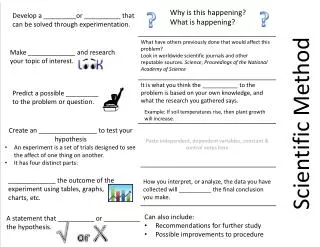
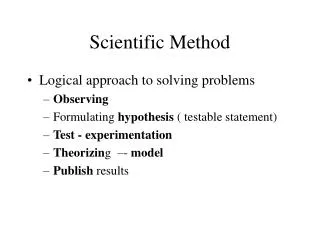
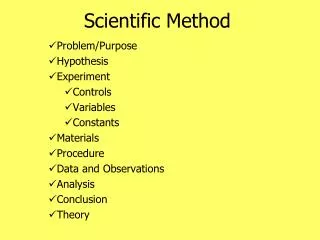
Scientific Method A way of problem solving that involves experimentation, observation and data collection.
Before you begin…..Make observations and research what you are trying to test. • Use your senses • Use tools • Observations can be • Objective based on facts • Subjective based on opinion
Before you begin…..State the problem by identifying what you are trying to test. • Use your observations and research • The problem can be stated in the form of a question. • Ex. Which type of cream works best on poison ivy?
Before you begin…..Determine your variables. (dependent and independent variables) • A variable is a factor that affects the outcome of an experiment • Independent variable is manipulated • What you changed. • Graphed on the x axis. • Dependent variable responds. • What happens because of what you changed. • Graphed on the y axis
Variables continued… • The independent variable and the dependent variable are stated in the problem. • Which type of cream (independent) works best (size of rash) on poison ivy?
Before you begin….Form a hypothesis • A hypothesis is an educated guess based on your research and observations. • It must be testable. • It is stated as • If (independent variable) then (dependent variable)
During the experiment you will test your hypothesis. • The steps of the experiment must be specific enough so that anyone could repeat your process exactly. • Your design should include a control group which receives the placebo or nothing. The control is used as your standard for comparison. • Your design should include an experimental group that receives the independent variable. • With in your experimental group constants must be maintained to insure accuracy.
During the experiment you should make observations and collect data. • The experiment may provide you with quantitative data ( numbers) or qualitative data (descriptions) or both. • Data should be collected and organized in a chart or graph.
After the experiment you should formulate a conclusion based on your hypothesis. • The conclusion is based on the data and hypothesis. • You should support your conclusion using specific data you collected. • You must also include validity and areas for improvement.