Investigating Tidal and Wave Energy Capture with Advanced Turbine Models at Southampton
10 likes | 180 Vues
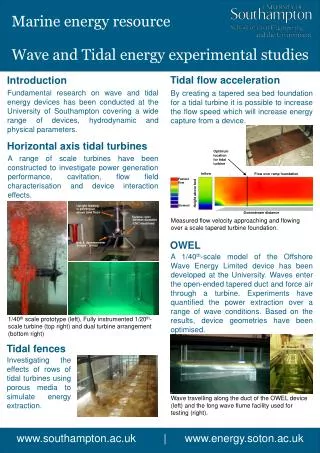
This research at the University of Southampton explores innovative tidal and wave energy devices to improve energy capture efficiency. By utilizing tapered sea bed foundations for tidal turbines, we aim to enhance flow speeds and optimize power generation. Various scales of tidal turbines have been constructed for detailed analysis on performance and interaction effects. Our studies include the Offshore Wave Energy Limited (OWEL) device, demonstrating how properly designed structures can maximize energy extraction in different wave conditions.


Investigating Tidal and Wave Energy Capture with Advanced Turbine Models at Southampton
E N D
Presentation Transcript
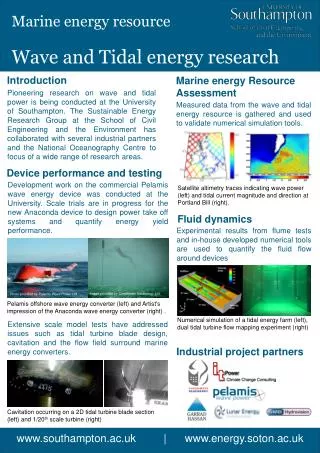
Fastest flow Slowest Hub & dynamometer -torque / thrust Upright leading Turbine rotor -800mm diameter to power train -CNC machined above tank floor Marine energy resource Wave and Tidal energy experimental studies Tidal flow acceleration Introduction Fundamental research on wave and tidal energy devices has been conducted at the University of Southampton covering a wide range of devices, hydrodynamic and physical parameters. By creating a tapered sea bed foundation for a tidal turbine it is possible to increase the flow speed which will increase energy capture from a device. Horizontal axis tidal turbines Optimum location for tidal turbine A range of scale turbines have been constructed to investigate power generation performance, cavitation, flow field characterisation and device interaction effects. Inflow Flow over ramp foundation Height above bed Downstream distance Measured flow velocity approaching and flowing over a scale tapered turbine foundation. OWEL A 1/40th-scale model of the Offshore Wave Energy Limited device has been developed at the University. Waves enter the open-ended tapered duct and force air through a turbine. Experiments have quantified the power extraction over a range of wave conditions. Based on the results, device geometries have been optimised. 1/40th scale prototype (left), Fully instrumented 1/20th-scale turbine (top right) and dual turbine arrangement (bottom right) Tidal fences Investigating the effects of rows of tidal turbines using porous media to simulate energy extraction. Wave travelling along the duct of the OWEL device (left) and the long wave flume facility used for testing (right). www.southampton.ac.uk | www.energy.soton.ac.uk




![[TIDAL WAVE AND OCEAN CURRENT ENERGY PRODUCTION]](https://cdn1.slideserve.com/1590527/tidal-wave-and-ocean-current-energy-production-dt.jpg)