
SlideServe
Menu
Préférences
© SlideServe · v2026

1 st Envisat Validation Workshop MERIS, December 2002 Conclusions and Recommendations

sharonhjones avatar
8 diapositives · 107 Views · Jan 02, 2020

This report summarizes the conclusions and recommendations from the Envisat Validation Workshop for the MERIS instrument. It covers topics such as calibration, in-flight verification, validation, and the performance of the instrument. The report also highlights the need for further data analysis and improvements in spectral characterization, degradation modeling, and radiative transfer codes.
1 st  Envisat Validation Workshop MERIS, December 2002  Conclusions and Recommendations - slide 1
01 / 81 st Envisat Validation Workshop MERIS, December 2002 Conclusions and Recommendations
1 / 17

Télécharger la présentation

1 st Envisat Validation Workshop MERIS, December 2002 Conclusions and Recommendations
Une image / un lien ci-dessous est fourni (tel quel) pour télécharger la présentation

Politique de téléchargement : le contenu du site vous est fourni TEL QUEL pour votre information et votre usage personnel ; il ne peut être vendu, concédé sous licence ni partagé sur d’autres sites sans l’accord de son auteur.Le contenu vous est fourni TEL QUEL, pour votre information et votre usage personnel uniquement. Téléchargez la présentation en cliquant sur ce lien. Lors du téléchargement, si vous ne parvenez pas à télécharger une présentation, l’éditeur a peut-être supprimé le fichier de son serveur.Pendant le téléchargement, si vous ne parvenez pas à obtenir une présentation, le fichier a peut-être été supprimé par l’éditeur.

F I N

Plus de contenu associé

Transcription de la présentation
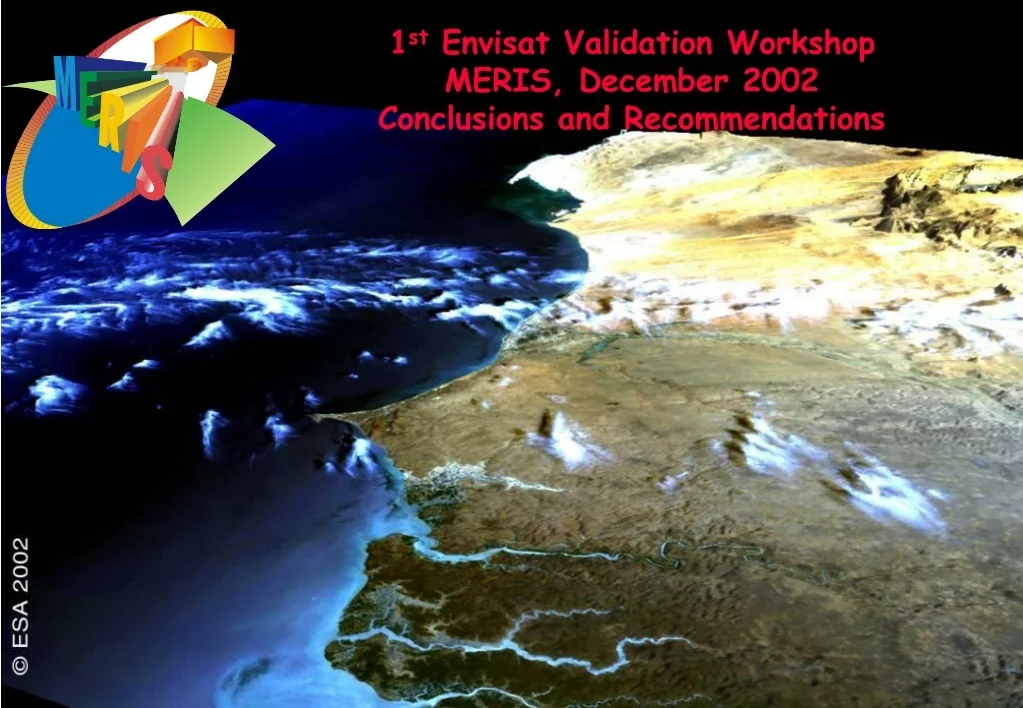
  1. 1st Envisat Validation Workshop MERIS, December 2002 Conclusions and Recommendations

  2. Plan Introduction Calibration In-flight Vicarious Verification Validation Cloud and Water Vapour Land Products Water Products Conclusion

  3. Introduction • Instrument works very well. • In-flight radiometric and spectral calibration performed regularly. Spectral calibration campaigns took place giving an in-flight spectral characterization results with unprecedented accuracy. • Verification activity was more demanding than originally expected but produced good results. • Following the verification phase, the vicarious calibration and the validation activities started. • First results have been presented during the workshop.

  4. Calibration Team Conclusions • Second spectral campaigns confirm early results. • - Overall accuracy 0.2 nm, resolution 0.05 nm • Radiometric calibration results showed only a little degradation in some of the cameras since launch (below 2.5%) • Vicarious calibration results (based on field measurements) showed good agreement (within the accuracy of the method used). • Inter comparison with AATSR showed good agreements. • Inter comparison results over desert sites showed an over estimation of Meris compared to last century’s sensors.

  5. Calibration Team Recommendations • Spectral characterization • Repeat spectral characterization campaigns every six months • Improve the instrument model using calibrated data • Instrument Degradation: • Include a pixel-wise degradation model in the L1b processing • Run a diffuser ageing calibration in SciLo configuration (planned) • BRDF modelling • Improve the BRDF model based on in-flight data • Develop a diffuser degradation model • Study the Speckle effect • Run a vigneting check for diffuser illumination extremes (planned)

  6. Calibration Team Recommendations • Radiative Transfer Codes • Inter-compare the Radiative Transfer Codes used for Vicarious Calibration • Tool Box Improvements • Include a L1b conversion to TOA reflectance & TOA normalized radiance • Include the RTC in the Toolbox for vicarious calibration exercises • METRIC Improvements • Include Snow, Buoys, instrumented site extraction • Include IOCCG Diagnostic data sites extraction • Calibration Plan • Systematic acquisition of data over designated targets and distribution via FTP • Hold Regular Cal/Val workshops

  7. Calibration Team Recommendations • Exploitation of available spectral campaign data • SeaWiFs, Chris/Proba • Programming of new spectral campaigns for radiometric calibration • Spot/Vegetation, ATM, MODIS, GLI, AATSR • Calibration Plan • Systematic comparison of MERIS and AATSR based on macro-pixels • Systematic acquisition of data over designated targets and distribution via FTP • Hold Regular Cal/Val workshops

  8. Conclusion • MERIS instrument is in very good shape and performs beyond spec. • The validation has started, however,more match up data are needed to conclude on the achieved accuracy. • More time is needed to look at the data and make a complete synthesis. • The first results look very promising (as per December 2002). • The products are now being distributed following smile correction update. • MERIS Image Data can be viewed through the Envisat homepage • http://envisat.esa.int and through the Multimedia Gallery from ESA’s homepage: www.esa.int