Unraveling the Atom: From Democritus to Modern Models
Explore the evolution of atomic theory from Democritus to Dalton and beyond. Learn about subatomic particles, the structure of the nucleus, and the concept of isotopes. Discover how early models shaped our understanding of the atom today.

Unraveling the Atom: From Democritus to Modern Models
E N D
Presentation Transcript
The Atom Chapter 4
Defining the AtomSection 4.1 • The lab technician shown here is using a magnifying lens to examine a bacterial culture in a petri dish. When scientists cannot see the details of what they study, they try to obtain experimental data that help fill in the picture.
Early Models of the Atom • An atom is the smallest particle of an element that retains its identity in a chemical reaction. • Philosophers and scientists have proposed many ideas on the structure of atoms.
Democritus’s Atomic Philosophy • How did Democritus describe atoms? Democritus
Democritus • Democritus believed that atoms were indivisible and indestructible. • Democritus’s ideas were limited because they didn’t explain chemical behavior and they lacked experimental support
Dalton’s Atomic Theory • By using experimental methods, Dalton transformed Democritus’s ideas on atoms into a scientific theory. • The result was Dalton’s atomic theory.
Dalton’s Atomic Theory • All elements are composed of tiny indivisible particles called atoms.
Atoms of different elements can physically mix together or can chemically combine in simple whole-number ratios to form compounds. Atoms of the same element are identical. The atoms of any one element are different from those of any other element.
Dalton’s Atomic Theory • Chemical reactions occur when atoms are separated, joined, or rearranged. Atoms of one element are never changed into atoms of another element in a chemical reaction.
Sizing Up The Atom • Iron Atoms Seen Through a Scanning Tunneling Microscope
Structure of The Atom Section 4.2
Structure of the Nuclear Atom • Cathode-ray tubes are found in TVs, computer monitors, and many other devices with electronic displays.
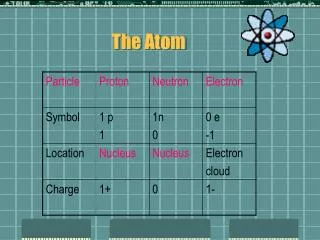
Subatomic Particles • Three kinds of subatomic particles are electrons, protons, and neutrons.
Electrons • In 1897, the English physicist J. J. Thomson (1856–1940) discovered the electron. Electrons are negatively charged subatomic particles.
Cathode Ray Tube • Thomson performed experiments that involved passing electric current through gases at low pressure. The result was a glowing beam, or cathode ray, that traveled from the cathode to the anode.
Cathode Ray Tube • A cathode ray is deflected by a magnet. • Thomson concluded that a cathode ray is a stream of electrons. Electrons are parts of the atoms of all elements.
Protons and Neutrons • In 1886, Eugene Goldstein (1850–1930) observed a cathode-ray tube and found rays traveling in the direction opposite to that of the cathode rays. He concluded that they were composed of positive particles. • Such positively charged subatomic particles are called protons. • In 1932, the English physicist James Chadwick (1891–1974) confirmed the existence of yet another subatomic particle: the neutron. • Neutrons are subatomic particles with no charge but with a mass nearly equal to that of a proton.
The Atomic Nucleus • J.J. Thompson and others supposed the atom was filled with positively charged material and the electrons were evenly distributed throughout. • This model of the atom turned out to be short-lived, however, due to the work of Ernest Rutherford (1871–1937).
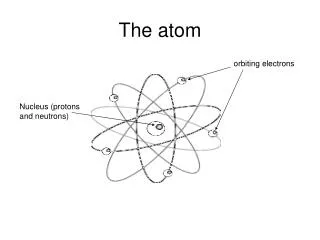
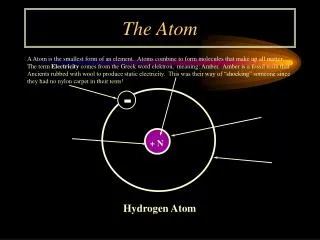
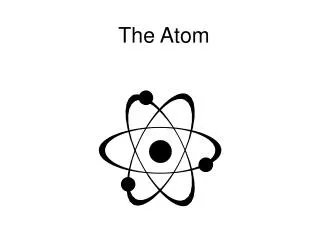
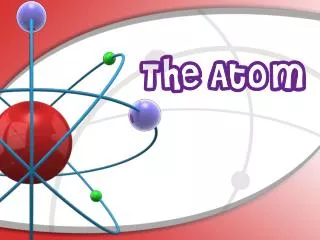
The Rutherford Atomic Model • Rutherford concluded that the atom is mostly empty space. All the positive charge and almost all of the mass are concentrated in a small region called the nucleus. • The nucleus is the tiny central core of an atom and is composed of protons and neutrons • In the nuclear atom, the protons and neutrons are located in the nucleus. • The electrons are distributed around the nucleus and occupy almost all the volume of the atom.
Distinguishing Among Atoms • Just as apples come in different varieties, a chemical element can come in different “varieties” called isotopes.
Atomic Number • Elements are different because they contain different numbers of protons. • The atomic number of an element is the number of protons in the nucleus of an atom of that element.
Mass Number • The total number of protons and neutrons in an atom is called the mass number. • The number of neutrons in an atom is the difference between the mass number and atomic number.
Mass Number • Au is the chemical symbol for gold.
Isotopes • Isotopes are atoms that have the same number of protons but different numbers of neutrons. • Because isotopes of an element have different numbers of neutrons, they also have different mass numbers.
Isotopes • Despite these differences, isotopes are chemically alike because they have identical numbers of protons and electrons.
Atomic Mass • It is useful to to compare the relative masses of atoms to a standard reference isotope. Carbon-12 is the standard reference isotope. Cabon-12 has a mass of exactly 12 atomic mass units. • An atomic mass unit (amu)is defined as one twelfth of the mass of a carbon-12 atom.
Atomic Mass • The atomic massof an element is a weighted average mass of the atoms in a naturally occurring sample of the element. • A weighted average mass reflects both the mass and the relative abundance of the isotopes as they occur in nature.
Atomic Mass • To calculate the atomic mass of an element, multiply the mass of each isotope by its natural abundance, expressed as a decimal, and then add the products. • For example, carbon has two stable isotopes: • Carbon-12, which has a natural abundance of 98.89%, and • Carbon-13, which has a natural abundance of 1.11%.
The Periodic Table • A periodic tableis an arrangement of elements in which the elements are separated into groups based on a set of repeating properties. • A periodic table allows you to easily compare the properties of one element (or a group of elements) to another element (or group of elements).