Understanding Cellular Respiration: Aerobic and Anaerobic Processes
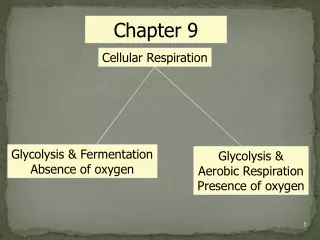
Cellular respiration is a vital biochemical process that converts food molecules, primarily glucose, into usable energy in the form of ATP. This process can occur in two main forms: aerobic respiration, which requires oxygen and produces up to 36 ATP molecules per glucose molecule, and anaerobic respiration, which occurs without oxygen and yields only 2 ATP molecules. Anaerobic respiration includes lactic acid fermentation, causing muscle fatigue, and alcoholic fermentation, utilized in alcohol production. Both processes play crucial roles in energy metabolism in cells.

Understanding Cellular Respiration: Aerobic and Anaerobic Processes
E N D
Presentation Transcript
Cellular Respiration Energy For Cells
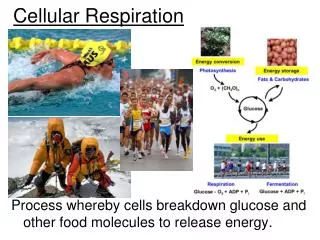
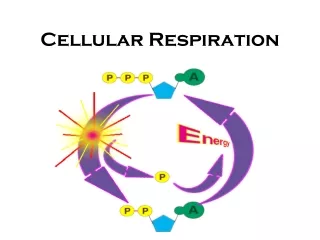
Cellular Respiration • Energy is released by breaking the bonds of food molecules (such as glucose) to make ATP from ADP • ADP = adenosine diphosphate • ADP + Pi ATP • 2 types • aerobic respiration • anaerobic respiration
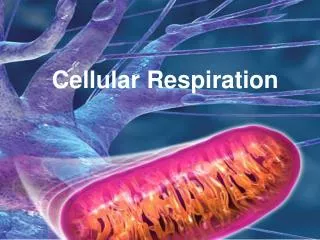
Aerobic Respiration • respiration that requires oxygen • starts in the cytoplasm • glycolysis • moves to the mitochondria • Krebs Cycle • Electron Transport Chain
Aerobic Respiration • C6H12O6 + 6O2 6CO2 + 6H2O • 38 ATP are produced per molecule of glucose • 2 ATP are used, so net ATP is 36 • Some energy is lost as heat, so the actual number will be lower • exergonic reaction – energy is released
Anaerobic Respiration • takes place in the absence of oxygen • Fewer ATP are produced – net ATP is 2 • 2 types • Lactic acid fermentation • Alcoholic fermentation
Lactic Acid Fermentation • Enzymes break down a glucose molecule into two lactic acid molecules, transferring energy to ATP • C6H12O6 + 4ADP + 4Pi lactic acid + 4ATP • This process causes the pain in muscle fatigue
Alcoholic Fermentation • Enzymes break down a glucose molecule into two molecules of ethanol and two molecules of CO2, transferring energy to ATP • C6H12O6 + 4ADP + 4Pi 2 ethanol + 2 CO2 + 4ATP • This process is used… • to produce alcohol • in gasoline additives • baking