Download
1 / 4
40 likes | 209 Vues
This article delves into the concepts of refraction, including the definitions of angles α and β, and explains the key term 'refraction' as the change in speed and direction of waves when transitioning between mediums. Using Snell’s law, we will calculate the speed (v2), wavelength (λ2), frequency (f), and period (T) for provided parameters: α = 42°, β = 30°, v1 = 7 m/s, and λ1 = 2 m. Additionally, we explore the concept of refractive indices, both absolute and relative, and provide an example of light traveling from water to diamond.

E N D
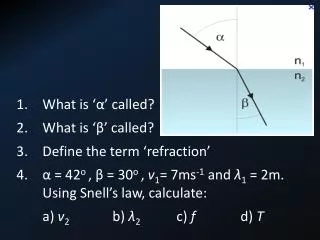
What is ‘α’ called? • What is ‘β’ called? • Define the term ‘refraction’ • α = 42o , β = 30o , v1= 7ms-1 and λ1 = 2m. Using Snell’s law, calculate: • a) v2 b) λ2 c) f d) T
Refractive Index Refraction is change in speed (and therefore direction) when waves move from medium to another. Refractive index is the ratio of the speed of waves in one medium to another.
n1 , n2 , n3 , … = absolute refractive index 1n2 = relative refractive index where: Example: If light travels from water to diamond, what would be the relative refractive index?