Understanding Ecology: Interactions Between Organisms and Their Environments
Ecology is the scientific study of how organisms interact with each other and their environments, focusing on energy transfer and relationships. It encompasses biotic factors (living organisms) and abiotic factors (nonliving elements like temperature and soil). Key concepts include organisms, populations, communities, ecosystems, and the biosphere, which represent different levels of biological organization. Ecology also covers the roles of producers and consumers in food chains and webs, as well as symbiotic relationships. This foundational knowledge helps us understand the balance of life on Earth.

Understanding Ecology: Interactions Between Organisms and Their Environments
E N D
Presentation Transcript
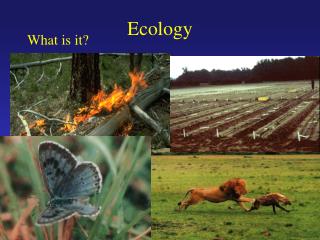
What is ecology? Ecology-the scientific study of interactions between organisms and their environments, focusing on energy transfer • It is a science of relationships.
What do you mean by environment? The environment is made up of two factors: Biotic factors- all living organisms inhabiting the Earth Abiotic factors- nonliving parts of the environment (i.e. temperature, soil, light, moisture, air currents)
Biosphere Ecosystem Community Population Organism
Organism-any unicellular or multicellular form exhibiting all of the characteristics of life, an individual. • The lowest level of organization
Population-a group of organisms of one species living in the same place at the same time that interbreed and compete with each other for resources (ex. food, mates, shelter)
Community- several interacting populations that inhabit a common environment and are interdependent.
Ecosystem-communities and the abiotic factors with which they interact (ex. marine, terrestrial)
Biosphere- life supporting portions of Earth composed of air, land, fresh water, and salt water. • The highest level of organization
Niche -the role a species plays in a community (job) Habitat- the place in which an organism lives out its life (address) Habitat vs. Niche
Feeding Relationships Producer- AKA Autotrophs • Get their energy by making glucose through photosynthesis • Bottom of the food chain
Feeding Relationships Consumer- all heterotrophs: they ingest food containing the sun’s energy • Herbivores • Carnivores • Omnivores • Decomposers • Scavengers
Feeding Relationships Consumer- Herbivores • Eat plants • Primary consumers
Feeding Relationships Consumer-Carnivores-eat meat • Predators • Hunt prey animals for food.
Feeding Relationships Consumer- Carnivores- eat meat • Scavengers • Feed on carrion, dead animals
Feeding Relationships Consumer- Omnivores-eat both plants and animals
Feeding Relationships Consumer- Decomposers • Breakdown the complex compounds of dead and decaying plants and animals into simpler molecules that can be absorbed
Symbiotic Relationships 3 Types of symbiosis: 1. Commensalism 2. Parasitism 3. Mutualism Symbiosis- two speciesliving together
Symbiotic Relationships Commensalism- Good/Don’t Care one species benefits and the other is neither harmed nor helped Ex. orchids on a tree Epiphytes: A plant, such as a tropical orchid or a bromeliad, that grows on another plant upon which it depends for mechanical support but not for nutrients. Also called aerophyte, air plant.
Symbiotic Relationships Commensalism- Good/Don’t Care one species benefits and the other is neither harmed nor helped Ex. Whale and barnacle
Symbiotic Relationships Parasitism- Good/Bad one species benefits (parasite) and the other is harmed (host) • Parasite-Host relationship
Symbiotic Relationships Parasitism- parasite-host Ex. lampreys, leeches, fleas, ticks,tapeworm
Symbiotic Relationships Mutualism- Good/Good beneficial to both species Ex. cleaning birds and cleaner shrimp
Symbiotic Relationships Mutualism- beneficial to both species Ex. lichen
Fungus living on the roots of plants Mutualism
Trophic Levels • Each link in a food chain is known as a trophic level. • Trophic levels represent a feeding step in the transfer of energy and matter in an ecosystem.
Trophic Levels Biomass- the amount of organic matter comprising a group of organisms in a habitat. • As you move up a food chain, both available energy and biomass decrease. • Energy is transferred upwards but is diminished with each transfer.
Less Energy Than Trophic Levels E N E R G Y Tertiary consumers- top carnivores Secondary consumers-small carnivores Primary consumers- Herbivores Producers- Autotrophs MOST AMOUNT OF AVAILABLE ENERGY
Trophic Levels Food chain- simple model that shows how matter and energy move through an ecosystem
Trophic Levels Food web- shows all possible feeding relationships in a community at each trophic level • Represents a network of interconnected food chains
Food chain Food web (just 1 path of energy) (all possible energy paths)
Primary Succession- When a small community of living things begin to live in an area that did not previously contain plants or animals.
Secondary Succession- When an existing community is destroyed and the original plant community regrows. A disturbance is any event that interrupts life in an ecosystem. Examples: A forest fire, cutting down trees, animals grazing in a field, farming.
1.Tropical Rainforest – hot, humid, heavy rainfall, tall trees, occur around the equator, many different species; most live in the canopy, birds, frogs, snakes, monkeys
2. Taiga – coniferous forest; long cold winters; Canada; usually only one or two types of conifers- evergreen trees like pines, bear, caribou, deer, elk, beaver
3. Temperate Deciduous Forest – Eastern U.S. ; leaves of trees change color, warm summers and mild winters; maple, oak, and elm trees, squirrel, deer, fox
4. Desert – hot in the daytime, cold at night; dry; Africa; U.S.; Australia, plants and animals exhibit adaptations and behaviors that help them conserve water; cactus, short shrubs, scorpions, rodents, and snakes.