example
This document outlines the methodology for designing and optimizing logistics networks within the public sector. It discusses specific examples involving edges in a logistics network and their impact on lower and upper boundaries. By applying a systematic approach, edges are analyzed and removed based on their lower boundary conditions to achieve an efficient configuration. The study culminates in identifying the absolute center and radius, demonstrating the effectiveness of the proposed logistics management framework.

example
E N D
Presentation Transcript
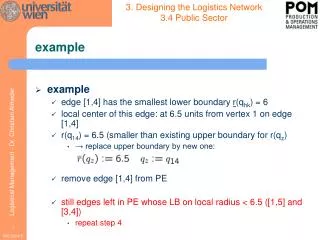
3. Designing the Logistics Network3.4 Public Sector example • example • edge [1,4] has the smallest lower boundary r(qhk) = 6 • local center of this edge: at 6.5 units from vertex 1 on edge [1,4] • r(q14) = 6.5 (smaller than existing upper boundary for r(qz) • → replace upper boundary by new one: • remove edge [1,4] from PE • still edges left in PE whose LB on local radius < 6.5 ([1,5] and [3,4]) • repeat step 4 Logistical Management - Dr. Christian Almeder
3. Designing the Logistics Network3.4 Public Sector example • example • edge [1,5] has smallest lower boundary r(qhk) = 6 • local center of this edge: at 2 units from vertex 1 on edge [1,5] • r(q15) = 9 (NOT smaller than existing upper boundary for r(qz)) • no update for UB of absolute radius (remains at 6.5) • remove edge [1,5] from PE • still edge left in PE whose LB on local radius < 6.5 ([3,4]) • repeat step 4 Logistical Management - Dr. Christian Almeder
3. Designing the Logistics Network3.4 Public Sector example • example • edge [3,4] has smallest lower boundary r(qhk) = 6 • local center of this edge: in vertex 4 • r(q34) = 7 (NOT smaller than existing upper boundary for r(qz)) • no update for UB for absolute radius (remains at 6.5) • remove edge [3,4] from PE • no more edge in PE • final solution • absolute center: at 6.5 units from vertex 1 on edge [1,4] • absolute radius: 6.5 Logistical Management - Dr. Christian Almeder