Exploring Recursion and Its Wonders in Computing – Lecture 10 at UC Berkeley
In this insightful lecture by Dan Garcia and Toby Shachman at UC Berkeley, we delve into the beauty and joy of computing through the concept of recursion. The presentation explores "Recursive Drawing," a spatial programming language allowing users to create intricate drawings with no code. We also examine the factorial function and the Fibonacci sequence, highlighting their inductive definitions and the order of growth in recursive calls. Through projects like the Menger Cube and discussions on change-making problems, participants will discover the power and elegance of recursion in computational problem-solving.

Exploring Recursion and Its Wonders in Computing – Lecture 10 at UC Berkeley
E N D
Presentation Transcript
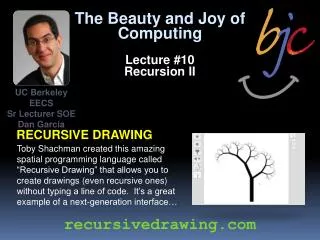
The Beauty and Joy of ComputingLecture #10Recursion II UC Berkeley EECSSr Lecturer SOEDan Garcia Toby Shachman created this amazing spatial programming language called “Recursive Drawing” that allows you to create drawings (even recursive ones) without typing a line of code. It’s a great example of a next-generation interface… Recursive drawing recursivedrawing.com
How the Computer Works … n! • Factorial(n) = n!Inductive definition: • n! = 1 , n = 0 • n! = n * (n-1)!, n > 0 • Let’s act it out… • “contractor” model • 5!
Order of growth of # of calls of n! • Constant • Logarithmic • Linear • Quadratic • Exponential (source: FallingFifth.com)
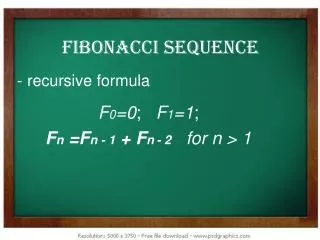
en.wikipedia.org/wiki/Fibonacci_numberwww.ics.uci.edu/~eppstein/161/960109.htmlen.wikipedia.org/wiki/Fibonacci_numberwww.ics.uci.edu/~eppstein/161/960109.html How the Computer Works … fib(n) • Inductive definition: • fib(n) = n , n < 2 • fib(n) = fib(n-1)+fib(n-2), n > 1 • Let’s act it out… • “contractor” model • fib(5) Let’s now: trace… (gif from Ybungalobill@wikimedia) Leonardo de Pisaaka, Fibonacci
Order of growth of # of calls of fib(n) • Constant • Logarithmic • Linear • Quadratic • Exponential Chimney of Turku Energia, Turku, Finland featuring Fibonacci sequence in 2m high neon lights. By Italian artist Mario Merz for an environmental art project. (Wikipedia)
Counting Change (thanks to BH) • Given coins {50, 25, 10, 5, 1} how many ways are there of making change? • 5 • 2 (N, 5P) • 10 • 4 (D, 2N, N5P, 10P) • 15 • 6 (DN, D5P, 3N, 2N5P, 1N10P, 15P) • 100?
Call Tree for “Count Change 10 (10 5 1)” Skip Coin Use Coin D? N? D N? P? P? P? NN P? P? P? P? P? P? P? P? P? N 5P P? P? P? 10P
“I understood Count Change” • Strongly disagree • Disagree • Neutral • Agree • Strongly agree img4.joyreactor.com/pics/post/drawing-recursion-girl-275624.jpeg
Summary • It’s important to understand the machine model • It’s often the cleanest, simplest way to solve many problems • Esp those recursive in nature! • Recursion is a very powerful idea, often separates good from great (you’re great!) Menger Cube by Dan Garcia