Structure and Governance of the Republic of India: An Overview
The Republic of India features a complex administrative structure divided into 25 states and 476 districts, governed by a unique framework that emphasizes the separation of powers among the legislative, executive, and judicial branches. The President serves as the head of state while the Prime Minister heads the government, supported by the Council of Ministers. India prides itself on its democratic principles, ensuring representation for diverse groups. Understanding the roles of different government bodies, including the Supreme Court, Rajya Sabha, and Lok Sabha, is crucial for grasping the operational framework of this sovereign and secular nation.

Structure and Governance of the Republic of India: An Overview
E N D
Presentation Transcript
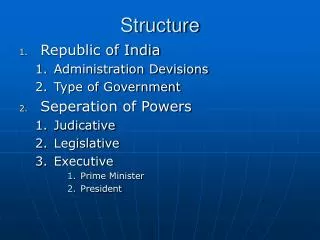
Structure • Republic of India • Administration Devisions • Type of Government • Seperation of Powers • Judicative • Legislative • Executive • Prime Minister • President
Republic of India - Administration Divisions - • Devided in 25 states with 476 districts • Head of the states: governors appointed by President • Districts devided in taluqs or tehsils contain from 200 to 600 villages controlled by Lieutenant Governor or Chief Commissioner who are appointed by the President
Type of Government • Sovereign independent • Socialist/secular religious tolerance, no discrimination • Democratic elected, allocated seats for special castes and tribes and also for women • Republic head of the state is elected by an electoral college for fives years
Seperation of Powers - Judicative - • Judicial system began under the British • Consits of the Supreme Court of India, High Courts and District and Session Courts • The Supreme Court consits of the Chief Justice and 25 associate justices appointed by the President
- Legislature - • Consits of the Council of States (Rajya Sabha) and the House of the People (Lok Sabha) • The Council of States is subordinated to the House of People • 542 members of the House of People are elected by the states
- Executive - • The main national executive power Council of Ministers • Led by the Prime Minister (Head of Government) • 3 types of ministers: Cabinet Ministers, Minister of State and deputy ministers
President • Head of States • Supreme commander of the Indian armed forces • Is elected by the elected members of the Parliament
Todays President • Smt. Pratibha Devisingh Patil • was born on December 19, 1934 • the 12th President of India • First elected woman
Prime Minister • Head of Government • Leader of the Council of Ministers • Advises the President on all important matters • Link between the President and the Cabinet
Todays President • Dr. Manmohan Singh • fourteenth Prime Minister • Born on September 26, 1932 • Studied at the University of Cambridge, UK