Understanding Zwitterions and Structural Elements of Proteins
150 likes | 275 Vues
This chapter delves into the concept of zwitterions, which are molecules containing both positive and negative charges, and explores their behavior in different pH solutions. It discusses the primary (1o), secondary (2o), and tertiary (3o) structural elements of proteins, highlighting the importance of amino acid sequencing and fold patterns such as alpha helices and beta-pleated sheets. Key interactions, including disulfide linkages, salt bridges, and hydrogen bonding, are also examined in the context of protein structure and function, illustrating how these elements contribute to the overall characteristics of proteins.


Understanding Zwitterions and Structural Elements of Proteins
E N D
Presentation Transcript
Excerpt fromChapter 19:Proteins University of Louisiana at Lafayette CHEM 125, Leonard All images used with permission of publisher (Cengage Learning)
Zwitterion • A zwitterion has two oppositely charged ions • which exist in the same molecule. a O H3N CH C O R + − • The zwitterion can only exist in solution • which is at the isoelectric pH. 2
Zwitterion • If the pH is too low, the solution is too acidic, • the carboxylic salt end will gain H+. O O a H3N H3N CH CH C C OH O + H+ R R − + + a positive charge 3
Zwitterion • If the pH is too high, the solution is too basic. • The amine salt end will lose H+. O O a H3N H2N CH CH C C O O R R + − − − H+ negative charge 4
Structural Elements of Proteins I. 1o Structural Elements • The order and identity of each • amino acid in the protein is it’s • 1o structural element. • Diseases like sickle-cell anemia • is caused by a minor sequencing • error in the hemoglobin protein.
Structural Elements of Proteins II. 2o Structural Elements Small-scale folding patterns along the protein chain are the 2o structural elements: • Alpha (a) helix – a coil held together by • hydrogen bonds.
Structural Elements of Proteins • Alpha (a) helix – a coil held together by • hydrogen bonds.
Structural Elements of Proteins II. 2o Structural Elements Small-scale folding patterns along the protein chain are the 2o structural elements: • Alpha (a) helix – a coil held together by • hydrogen bonds. • Beta (b)-pleated sheet – a folded sheet-like • shape held together by hydrogen bonds.
Structural Elements of Proteins • Beta (b)-pleated sheet – a folded sheet-like • shape held together by hydrogen bonds.
Structural Elements of Proteins II. 2o Structural Elements
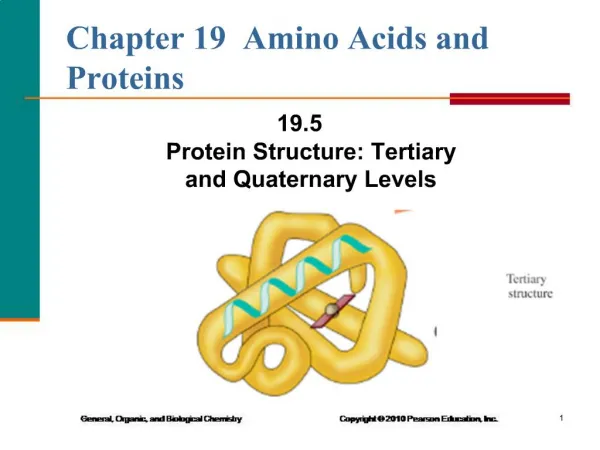
Structural Elements of Proteins III. 3o Structural Elements Large-scale folding patterns which show how 1 protein chain folds over itself: A. Disulfide Linkage – 2 cysteine amino acids can link their thiol R groups. B. Salt Bridge – attractions between the R groups of the acidic and basic amino acids. • Hydrogen Bonding – R groups with an • H attached to an O, N, or F is attracted to • other O, N, or F atoms. Hydrophobic Interactions – nonpolar R groups attract other nonpolar R groups.
Structural Elements of Proteins III. 3o Structural Elements
Structural Elements of Proteins III. 3o Structural Elements If the following two R groups were in close proximity along a protein chain, what 3o attractions would you see? a) O HO−CH2CH2−AA AA−C−NH2 hydrogen bonding
Structural Elements of Proteins III. 3o Structural Elements If the following two R groups were in close proximity along a protein chain, what 3o attractions would you see? b) CH3CH2-CH−AA AA−CH2CH3 CH3 hydrophobic interaction
Structural Elements of Proteins IV. 4o Structural Elements • Large-scale folding patterns which show • how 2 or more protein chains fold over • each other. Hemoglobin: made up of 4 protein chains.