Download
1 / 20

E N D
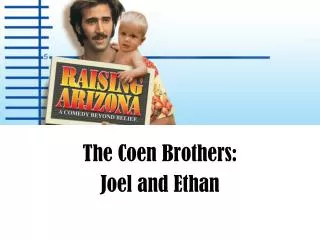
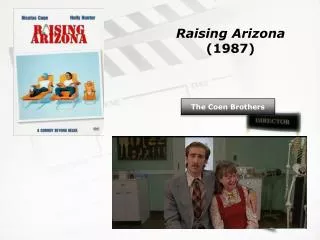
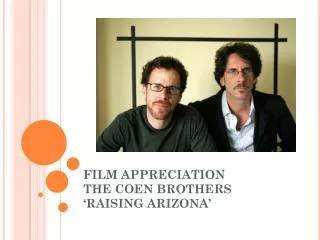
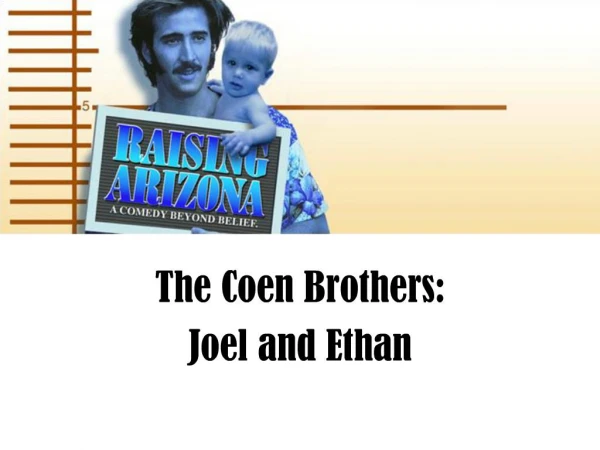
1. Raising Arizona The Coen Brothers:
Joel and Ethan
2. Joel Coen: “You start with things that are incredibly recognizable in one form, and then you play with them.”
3. Joel and Ethan Coen “they speak with a single creative voice . . . as a ‘two-man ecosystem’”
Function interchangeably on the set and work together every step of the filmmaking process
Joel named as director
Ethan named as producer
Roderick Jaynes: pseudonym for their editorial work
Writers: “Their screenplays are renowned for their attention to such production factors as set design, camera angles and movement, and framing… their scripts manage to convey a vivid sense of the finished film.”
Work with a regular cast of colleagues and actors who “can feel their way through it, kind of like (the Coens) can.”
4. Schizophrenia & Postmodern Andrew Moss
“simulate symptoms of schizophrenia in their viewers”
“In film theory, this ‘breakdown’ occurs within the semiotics of the cinematographic image—editing and depth of field—splitting the viewer between two incommensurable narratives”
“Postmodernism suggests multiple and irreconcilable realities.”
5. Andrew Moss While “often designated a screwball comedy, a farce, and/or a black comedy . . . . Beyond its hick wit, however, lies the deeply psychological fate of a man battling his own divided soul.”
It’s “very narrative depends upon the incompatibility of opposing forces”
“We all live in media res.”
6. Storyboarding—Todd Anderson The Coens’ fanatical devotion to this practice is legendary.
They storyboard extensively; relatively little camera coverage or dialogue is improvised on their sets.
Economical—maximizes the conservation of time and money
7. Storyboarding An efficient way to communicate their ideas to the people with whom they collaborate, which in turn allows for greater preparedness on their parts.
8. Raising Arizona Voice-over narration
Storyteller’s mediation is ironically at odds with the story world circumstance
Juxtaposition of subjective point of view of narrative with the objective point of view of the camera creates humor
9. Clichéd Characters Characters are tragicomically transparent in their relationships to the cultural representations that dominate their lives
Encapsulates a time of American crisis: Reganomics & the destruction of the family unit
Their self-identities originate in the stereotypes, images, and phrases they have appropriated from various mass cultural sources.
H. I. McDunnough:
Narrator/protagonist exists most fully in the language he uses to describe his world
Cartoon universe represented by tattoo he shares with the biker
Recidivism & Reganomics: the chronic tendency toward repetition of criminal or antisocial behavior patterns caused by political climate
Ed
Drill Sergeant Attitude: Female police officer in a man’s world
Victim of Infertility: Heightened reaction to her infertility
Kidnapper bent on balancing the scales of justice: Fervent, felonious drive toward motherhood
Mother defending the sanctity of the “family unit”
10. Aesthetic Paradigm: Cartoon Color Palette Woody Woodpecker: http://video.google.com/videosearch?q=woody+woodpecker&rls=com.microsoft:en-us:IE-SearchBox&oe=UTF-8&sourceid=ie7&rlz=1I7ADBR_en&um=1&ie=UTF-8&ei=deOhSYbDG56Dtwfsh836DA&sa=X&oi=video_result_group&resnum=8&ct=title#
21. Credits Russell, Carolyn R. The Films of Joel and Ethan Coen